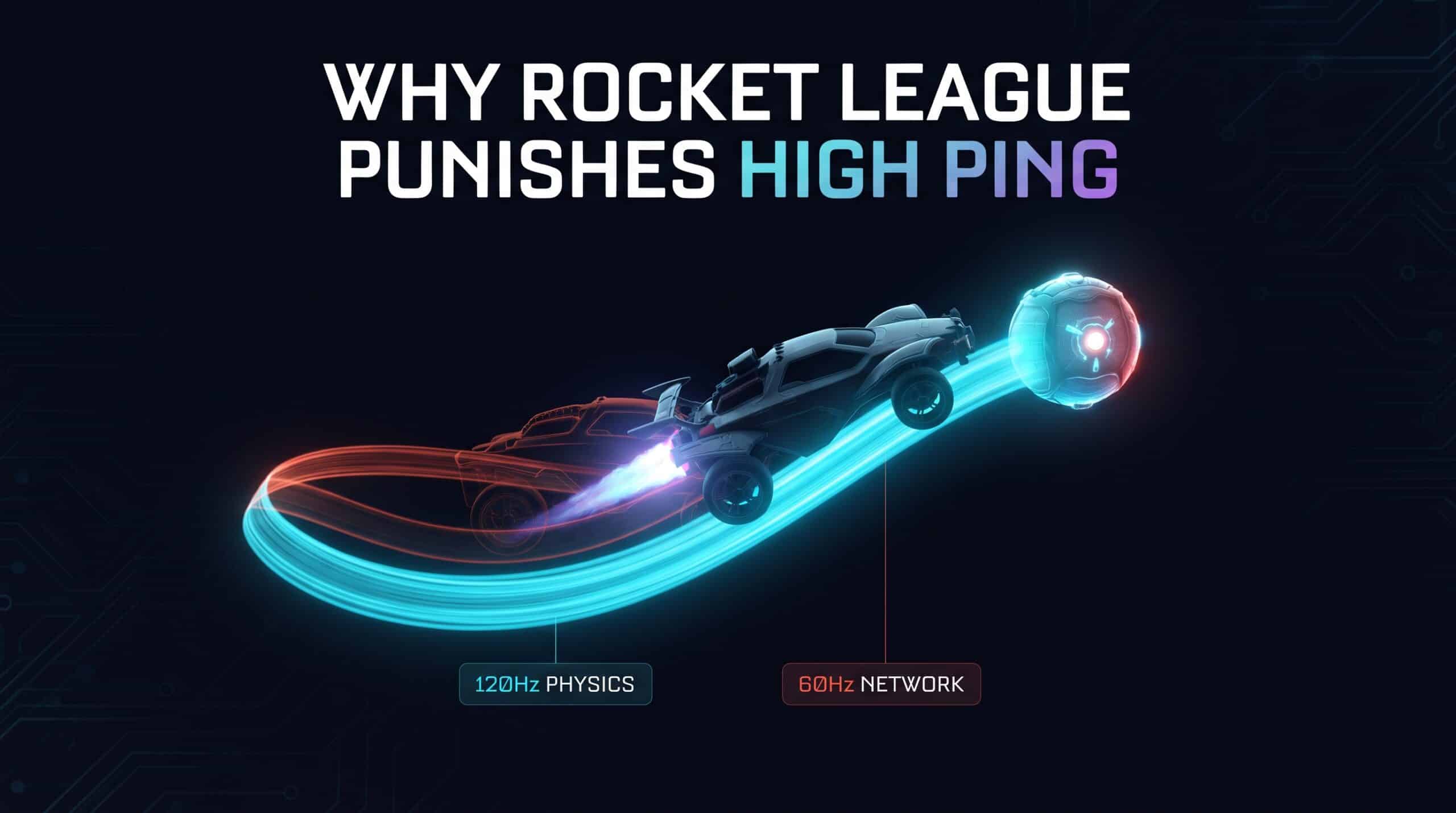
Rocket League punishes high ping harder than a lot of players expect from what looks, on the surface, like a fairly simple game — cars, a ball, a few mechanics. The reason lies in a specific technical detail most players never think to ask about: how fast the physics underneath that simple-looking game is actually running.
The Physics Runs Faster Than the Network
Rocket League’s physics simulation operates at 120Hz, confirmed directly by developer Psyonix, while network updates run at 60Hz — meaning the actual physical simulation is calculating twice as often as that information gets communicated across the network. This gap is deliberate and generally invisible in casual play, but it means any additional delay from your own connection compounds on top of a system that’s already reconciling two different update rates internally.
Why Precision Mechanics Expose This Gap
Aerial hits, precise dribbling, and fast rotations all depend on split-second physics interactions — exactly the kind of gameplay where the difference between the server’s 120Hz physics calculation and the 60Hz network update becomes something you can actually feel, especially when your own ping adds further delay on top. A car that’s slightly behind where the physics engine actually placed it, even briefly, is enough to whiff a shot that looked lined up perfectly on your screen.
Why Ball Physics Specifically Suffer Under Bad Ping
The ball in Rocket League follows genuinely complex physics — spin, bounce angles, and momentum all interact in ways that are unforgiving of any prediction error. High ping or inconsistent jitter means your client’s prediction of where the ball actually is drifts further from the server’s authoritative version, and unlike a simpler game where a small position error is barely noticeable, Rocket League’s precision-dependent mechanics make that drift immediately obvious the moment you go for a read that turns out to be wrong.
What Actually Helps Given This Physics Gap
A wired connection matters more here than in many other competitive games specifically because of how tightly physics and network timing interact — WiFi jitter doesn’t just delay your inputs, it actively worsens the mismatch between your local physics prediction and the server’s authoritative state. Server region selection remains relevant as always, and checking your ping consistency, not just the average number, matters especially given how precision-dependent the game’s core mechanics are.
Check your Rocket League ping and jitter with our Rocket League ping test, and test your overall connection with our free speed test.
Related Guides
- How to Reduce Ping: A Complete Guide
- Rocket League’s Physics Run at Double the Speed You See
- Low Ping vs Stable Ping
Frequently Asked Questions
Why does Rocket League feel so sensitive to ping compared to other games?
Its physics simulation runs at 120Hz while network updates run at 60Hz, a gap that’s normally invisible but becomes noticeable the moment your own ping adds further delay, especially during precision mechanics like aerials and fast dribbling.
Does high ping specifically affect ball physics?
Yes — the ball’s complex spin and momentum physics make any prediction drift caused by high ping or jitter immediately obvious, unlike simpler games where a small position error barely registers.