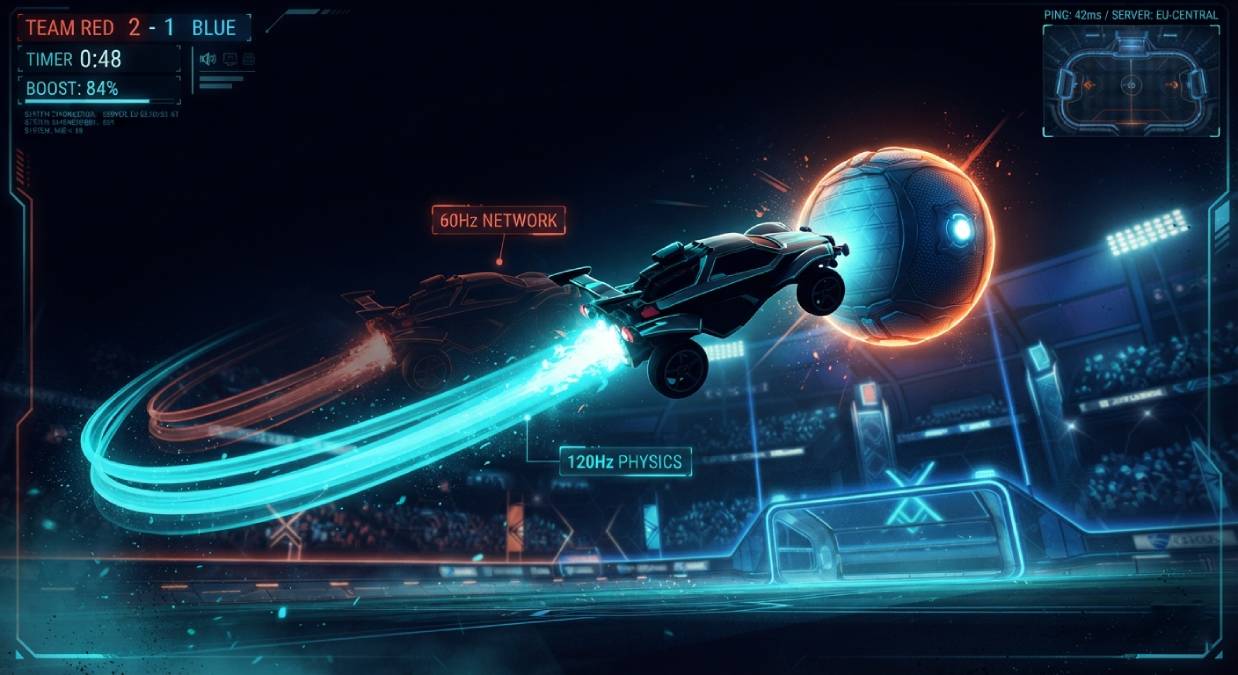
Rocket League feels different from almost every other online competitive game, and there’s a specific technical reason for that beyond “it’s cars playing soccer.” Psyonix’s own network developer confirmed at GDC that the game’s physics simulation — every collision, every flip reset, every millimeter-precise aerial touch — runs internally at 120Hz on both your machine and the server. But the network updates that keep your game synced with everyone else’s only go out at 60Hz. Half the resolution of the thing they’re describing.
Why This Split Exists at All
This isn’t an oversight or a cost-cutting measure — it’s a deliberate engineering tradeoff. Simulating physics at 120Hz gives Rocket League the precision its mechanics genuinely need; a car’s exact rotation and velocity during a wall read or an air dribble depends on very fine-grained calculation. But broadcasting every one of those 120 calculations per second over the network for every player in a match would be unnecessarily expensive in bandwidth for information that doesn’t meaningfully change how the match plays out. Sixty updates a second turns out to be enough to keep everyone’s screens close enough together — most of the time.
Why “Most of the Time” Is the Important Part
Rocket League’s physics are deterministic, meaning identical inputs always produce identical outcomes given the same starting state. That sounds like it should make synchronization easy, but it actually raises the stakes on any disagreement between your client and the server. Because everything is calculated from exact physical rules rather than approximated, even a tiny delay or jitter spike can cause your car’s position to visibly desync from what the server has calculated — a flip reset that should have connected doesn’t, an aerial touch that looked clean on your screen resolves differently once the server’s version catches up. This is precisely why Rocket League players are so sensitive to connection quality compared to players in less physics-precise games; the margin for error in a deterministic system is razor-thin by design.
The Engine Underneath Hasn’t Changed Since 2015
Rocket League still runs on a codebase built on Unreal Engine 3, dating back to the game’s original 2015 release, and the community has speculated for years about whether a future engine migration might eventually raise that 60Hz network ceiling. For now, the 120Hz internal simulation paired with 60Hz network updates remains the standard, which means your own connection stability is doing more direct work in this specific game than in almost any other title in competitive gaming — there’s no higher tick rate coming to compensate for a shaky connection.
Check your live ping and jitter to Rocket League’s servers with our Rocket League ping test, and for a deeper look specifically at jitter — which matters enormously here — see our jitter vs ping breakdown.
Related Guides
- Gamer Hub — All Game Ping Tests
- Rocket League Ping Test
- Gamer Speed Test
- Jitter vs Ping for Gaming
- Cable vs Fiber for Gaming
Frequently Asked Questions
Does Rocket League run at 60Hz or 120Hz?
Both, depending on what you’re referring to. Psyonix has confirmed the physics simulation runs at 120Hz on both client and server, but network updates between players are sent at 60Hz — half the internal simulation rate.
Why do my flip resets sometimes feel inconsistent online?
Rocket League’s deterministic physics require your client and the server to agree exactly on collision outcomes, and flip resets happen within very tight timing windows. Even small ping spikes or jitter can shift what the server registers versus what appeared on your screen.