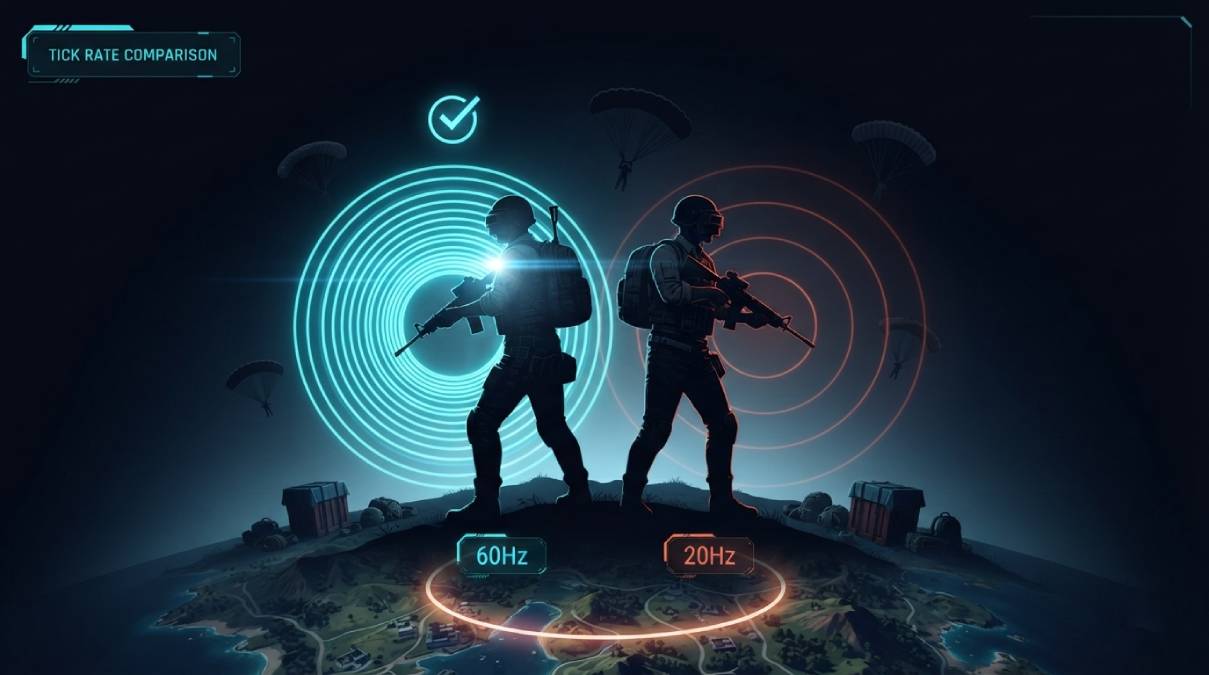
Ask most players to rank Fortnite, PUBG, Apex Legends, and Warzone by technical polish, and PUBG — the oldest of the four, the one that started the genre and has spent years fielding jokes about its optimization — usually lands somewhere near the bottom of that list. On one specific, measurable metric, that reputation is backwards. PUBG’s servers run at 60Hz, roughly double Fortnite’s tick rate and triple what Apex Legends or Warzone are commonly measured at, despite all four supporting the same 100-player lobby scale.
The Number Nobody Expected to Win the Comparison
Tick rate measures how many times per second a server updates the game world — player positions, hit registration, everything that has to be recalculated to keep everyone’s screen showing the same reality. PUBG Corporation runs its servers at 60Hz. Fortnite is generally cited around 30Hz. Apex Legends officially runs at 20Hz, a figure Respawn’s own engineers have confirmed and defended publicly. Warzone has never had an official number published by Activision, but independent community testing has consistently placed it around 20-25Hz. Line all four up, and the battle royale everyone associates with jank has the strongest technical foundation of the group by a wide margin.
| Game | Tick Rate | Source |
|---|---|---|
| PUBG | 60Hz | Community-confirmed, widely cited |
| Fortnite | ~30Hz | Generally cited, no single official figure |
| Warzone | ~20-25Hz | Community-tested, unconfirmed by Activision |
| Apex Legends | 20Hz | Officially confirmed by Respawn |
Why This Doesn’t Match the Reputation
A higher tick rate is a real structural advantage — more frequent server updates generally means less inherent delay baked into hit registration before your own connection even enters the equation. So why does PUBG still get the reputation it does? Community netcode analysis has repeatedly pointed to something other than tick rate as the actual source of PUBG’s biggest complaints: inconsistent hit detection in early-match encounters and damage that appears to register behind cover traces more often to inter-client delay and netcode handling than to how often the server itself updates. A high tick rate reduces one kind of problem without eliminating every other kind — it moves the bottleneck, it doesn’t erase it.
What This Actually Means for You
The practical takeaway isn’t “PUBG is secretly the best-networked battle royale, go play it” — it’s that tick rate alone is a poor predictor of how a game will actually feel, in either direction. A game can have an excellent tick rate and still produce frustrating moments from other causes, and a game with a lower tick rate can still feel fine for casual play if your own connection is clean. What tick rate does tell you is which part of the equation is already handled well by the developer, and which part is still on you. In PUBG’s case, once you’ve confirmed your own ping is low and stable, you’ve eliminated one of the larger variables that players in lower-tick games still have to fight against.
You can check your own live ping to PUBG’s regional servers at our PUBG ping test, and compare it directly against Fortnite or Warzone if you’re trying to decide which region gives you the cleanest connection across titles.
Related Guides
- Gamer Hub — All Game Ping Tests
- PUBG Ping Test
- Fortnite Ping Test
- Apex Legends Ping Test
- Warzone Ping Test
Frequently Asked Questions
Does PUBG really have a higher tick rate than Fortnite?
Yes. PUBG runs at 60Hz, roughly double the commonly cited figure for Fortnite (around 30Hz), despite both supporting similarly large 100-player lobbies.
If PUBG’s tick rate is better, why does it still feel inconsistent sometimes?
Community netcode analysis points to inter-client delay and netcode handling, not tick rate, as the bigger source of PUBG’s hit-registration complaints. A high tick rate helps, but it doesn’t fix every other source of inconsistency in an online shooter.