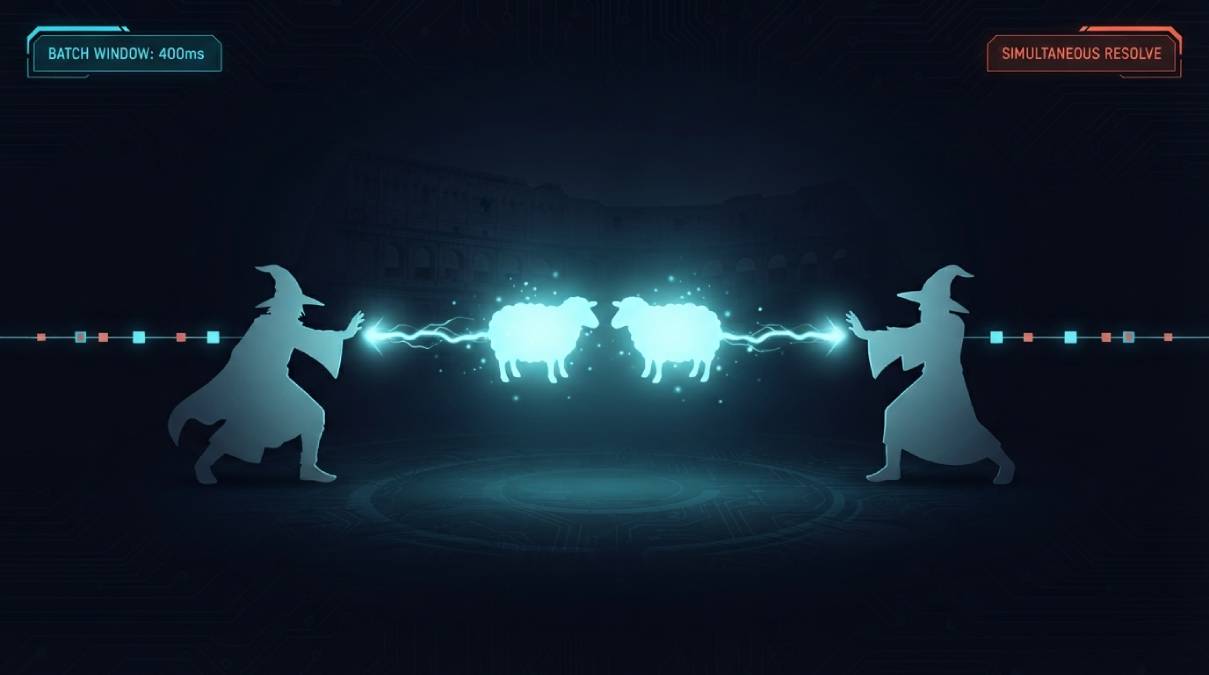
Picture two mages in a World of Warcraft Classic duel, both casting Polymorph on each other at nearly the same instant. In almost any other online game, one input would register a fraction of a second before the other, and one player would win the exchange. In WoW Classic, both mages turn into sheep. Simultaneously. Every time. It looks like a bug. Blizzard has confirmed, on the record, that it isn’t one.
A Server That Refuses to Pick a Winner
The mechanic is called spell batching, and it’s a deliberate piece of server architecture, not an oversight. In Classic WoW, any action one unit takes against another unit doesn’t resolve the instant it’s received — the server collects everything that arrives within a 400-millisecond window and processes it together, as if all of it happened at the same moment. If two mages both press Polymorph inside that same 400ms window, the server doesn’t care which packet technically arrived a few milliseconds earlier. It treats them as simultaneous, and both spells land.
This produces some genuinely strange, community-famous interactions that simply can’t happen on a faster, purely instant-resolution server. Two Warriors charging each other at the same moment can collide mid-air and stun each other. A Rogue’s opener and a Priest’s shield can land in the same batch, creating outcomes that look like the game glitched but are actually working exactly as designed.
Why Blizzard Kept the Quirk
Here’s the detail that makes this more than a curiosity — Blizzard has explicitly said this was a deliberate authenticity choice for Classic, recreating exactly how vanilla WoW behaved in 2004 through 2006, rather than a limitation of modern server hardware. Blizzard could easily run Classic on infrastructure fast enough to resolve actions individually and instantly. They chose not to, because doing so would change how combat actually plays out compared to the original game — and for a significant chunk of Classic’s audience, preserving that exact feel, quirks included, is the entire point of playing it.
Modern retail WoW doesn’t work this way anymore. Blizzard has confirmed that current servers process actions in roughly 1 to 10 milliseconds instead of a fixed 400ms window — a genuinely enormous responsiveness jump, and one reason retail combat feels meaningfully snappier than Classic even when your own connection is identical between the two.
What Actually Changes When You Improve Your Ping
This is the part worth understanding if you’re troubleshooting your own Classic experience: spell batching is a fixed, deliberate server-side design choice, and no amount of ping improvement removes it or gets around it. What your own connection quality does still control is everything stacked on top of that batching window — how quickly your inputs reach the server to be included in a batch in the first place, and how consistently. A high or unstable ping doesn’t create the sheep-duel phenomenon, but it does make your actions more likely to land in a later batch than you intended, which matters plenty in Arena and Rated Battlegrounds where timing is everything.
If you want to check exactly how your connection is performing right now, our World of Warcraft ping test measures live latency across every major region, and pairs well with a full jitter and packet loss check via the Gamer Speed Test if you’re chasing consistency, not just a low average number.
Related Guides
- Gamer Hub — All Game Ping Tests
- World of Warcraft Ping Test
- Diablo 4 Ping Test
- Jitter vs Ping for Gaming
- What Is a Good Ping for Gaming?
Frequently Asked Questions
Is spell batching a bug Blizzard is going to fix?
No — Blizzard has stated it’s a deliberate recreation of how the original 2004-2006 game behaved, not an unintentional limitation. It’s specific to Classic; modern retail WoW does not use the same 400ms batching system.
Does better internet remove spell batching in Classic WoW?
No. It’s a fixed server-side design choice that applies regardless of your own connection quality. A better connection improves how quickly and consistently your actions reach the server to be included in a batch, but it doesn’t remove the batching mechanic itself.