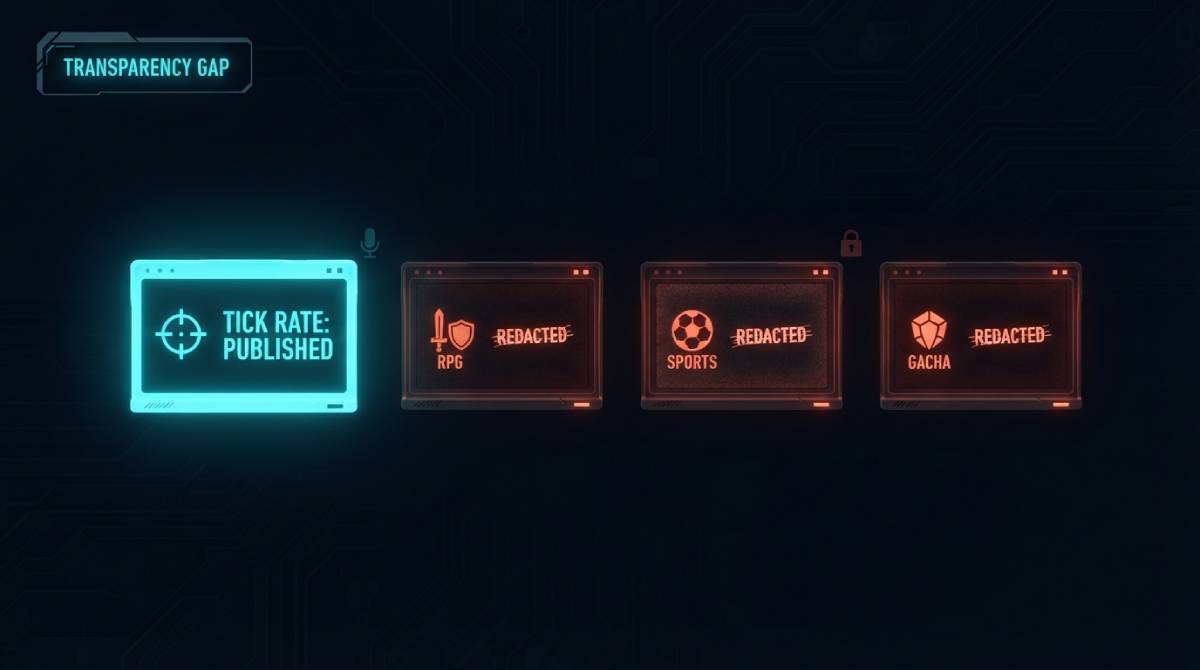
Riot has published Valorant’s 128-tick figure widely and repeatedly. 343 Industries went further and published the actual formula behind Halo Infinite’s hit registration. But EA has never published a tick rate for EA FC. Blizzard has never published one for Diablo 4. HoYoverse has never published one for Genshin Impact. Grinding Gear Games has never published one for Path of Exile 2. This isn’t a coincidence of four unrelated studios — it’s a pattern that lines up almost perfectly with genre.
The Genre That Gets Scrutinized, and the Genre That Doesn’t
Competitive shooters and tactical multiplayer games live and die by netcode transparency, because their entire competitive credibility depends on players trusting that hit registration is fair. That scrutiny creates real pressure on studios in that genre to publish, defend, and sometimes even apologize for their tick rate numbers — Apex Legends’ 20Hz became public precisely because Respawn’s own engineers chose to explain and defend the decision directly, rather than let community speculation fill the silence. ARPGs, sports titles, and gacha-style live-service games simply don’t face the same pressure. Nobody is building competitive rankings, sponsorship deals, or esports leagues around Diablo 4’s server tick rate the way they are around CS2’s or Valorant’s, so there’s far less incentive for those studios to ever publish a number at all.
What Fills the Silence When a Studio Doesn’t Publish
In the absence of an official figure, something else always becomes the actual explanation players reach for. For EA FC, confirmed reports on EA’s own support forums describe severe desync happening even with stable, low ping — pointing toward client-side performance and background software rather than network tick rate as the real culprit in most cases. For Diablo 4, the defining technical fact isn’t a tick rate at all, it’s that the game requires a constant server connection even during entirely solo play, with zero manual region selection available. For Path of Exile 2, the community’s own testing has converged on jitter — not raw ping — as the more useful metric to chase, since the game’s fast, particle-dense combat punishes inconsistency more than a slightly higher but stable ping.
Why This Pattern Is Actually Useful to Know
Recognizing this pattern changes how you troubleshoot a game in the silent category. Chasing a tick rate number that was never published and likely never will be is a dead end. What actually helps is identifying what that specific game’s community and available technical evidence points to instead — client-side performance for EA FC, jitter stability for Path of Exile 2, confirming your automatic region assignment for Diablo 4. The absence of an official number doesn’t mean there’s nothing useful to know; it means the useful thing to know is usually different from what shooter players are trained to look for.
Whatever the game, testing your own baseline connection is still the starting point — check it across every major region with our general server ping test.
Related Guides
- Gamer Hub — All Game Ping Tests
- Diablo 4 Ping Test
- Genshin Impact Ping Test
- Path of Exile 2 Ping Test
- EA FC Ping Test
Frequently Asked Questions
Why do some games never publish an official tick rate?
It largely comes down to genre and competitive scrutiny. Competitive shooters face heavy community and esports pressure to be transparent about netcode, while ARPGs, sports titles, and live-service games without competitive ranking systems don’t face the same pressure, so many studios in those genres simply never publish a figure.
If a game doesn’t publish its tick rate, is there nothing useful to check?
There’s usually still something useful — it’s just often different from tick rate. For EA FC that’s client-side performance, for Path of Exile 2 that’s jitter stability, and for Diablo 4 that’s confirming your automatic server region assignment, since manual selection isn’t available.