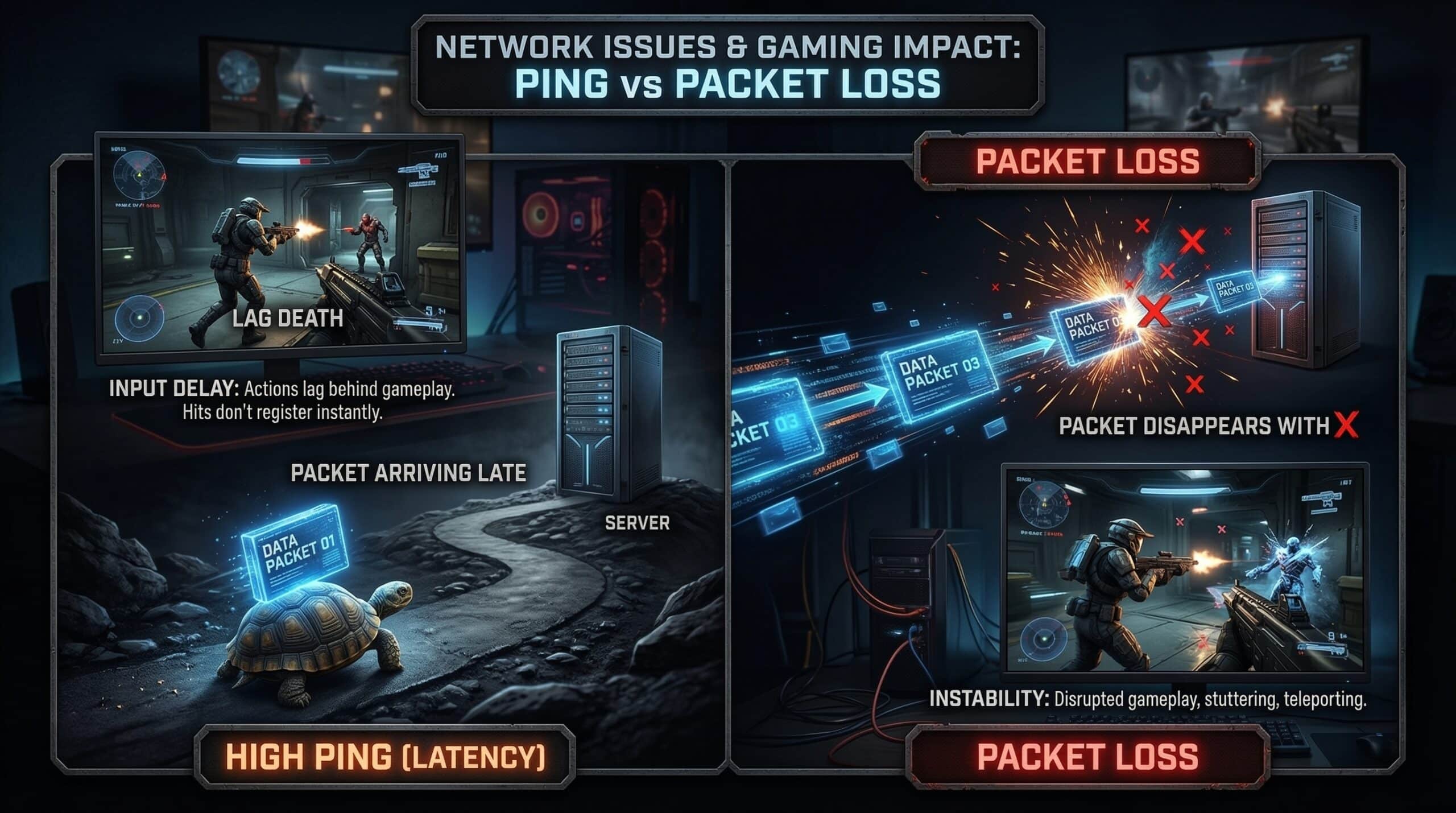
Packet Loss vs High Ping — What’s the Difference and Which Is Worse?
Both degrade online gaming and video calls, but they behave differently and have different causes. High ping means packets are slow; packet loss means packets disappear entirely. Measure both at instantspeedtest.net/ — both metrics are shown in the full test results.
Packet Loss vs High Ping — Side by Side Comparison
| Metric | High Ping | Packet Loss |
|---|---|---|
| What happens | Packets arrive slowly | Packets never arrive |
| Gaming symptom | Input lag, delayed responses | Teleporting, rubber-banding |
| Video call symptom | Slight audio/video delay | Audio dropouts, frozen video frames |
| Streaming symptom | Buffering startup time | Buffering mid-stream, quality drops |
| Common causes | Distance, congestion, ISP routing | WiFi signal loss, hardware faults, congestion |
| Which is worse? | Manageable at under 50ms | Even 1–2% causes serious real-time failures |
Why Packet Loss Is Worse Than High Ping
High ping is a delay — your actions happen, just 50ms later. This is consistent and the brain partially adapts to it. Packet loss is failure — your actions simply don’t happen. In gaming, a dropped packet means your shot, movement, or ability doesn’t register at all, then snaps forward when later packets arrive (the “rubber-banding” or “teleporting” effect). For video calls, packet loss causes sudden frozen frames and audio cutouts that are far more disruptive than the slight delay of high ping. A 60ms ping connection is playable; a 20ms ping connection with 3% packet loss is genuinely unplayable for competitive games.
Related Guides
- What Causes Packet Loss?
- How to Fix Packet Loss on WiFi
- Jitter vs Ping for Gaming
- What Is Ping?
- What Is Jitter?
- What Is a Good Ping for Gaming?
Frequently Asked Questions
Can you have high ping and packet loss at the same time?
Yes — congested network nodes cause both simultaneously. When a router or ISP node’s queue fills up, it drops packets (causing packet loss) while also adding queue delay to the packets that do pass through (causing high ping). Peak-hour cable congestion often produces both symptoms together: ping doubles from 20ms to 40ms while 2–5% packet loss appears during the same period.
How much packet loss is acceptable for gaming?
For casual gaming: under 2% is usually tolerable. For competitive gaming: 0% is the target — any packet loss affects gameplay. Even 0.5% packet loss in a game sending 60 packets per second means one dropped packet every ~3 seconds, which manifests as periodic rubber-banding. Professional gaming environments require 0% packet loss, which is why all esports venues use fiber and wired connections exclusively.