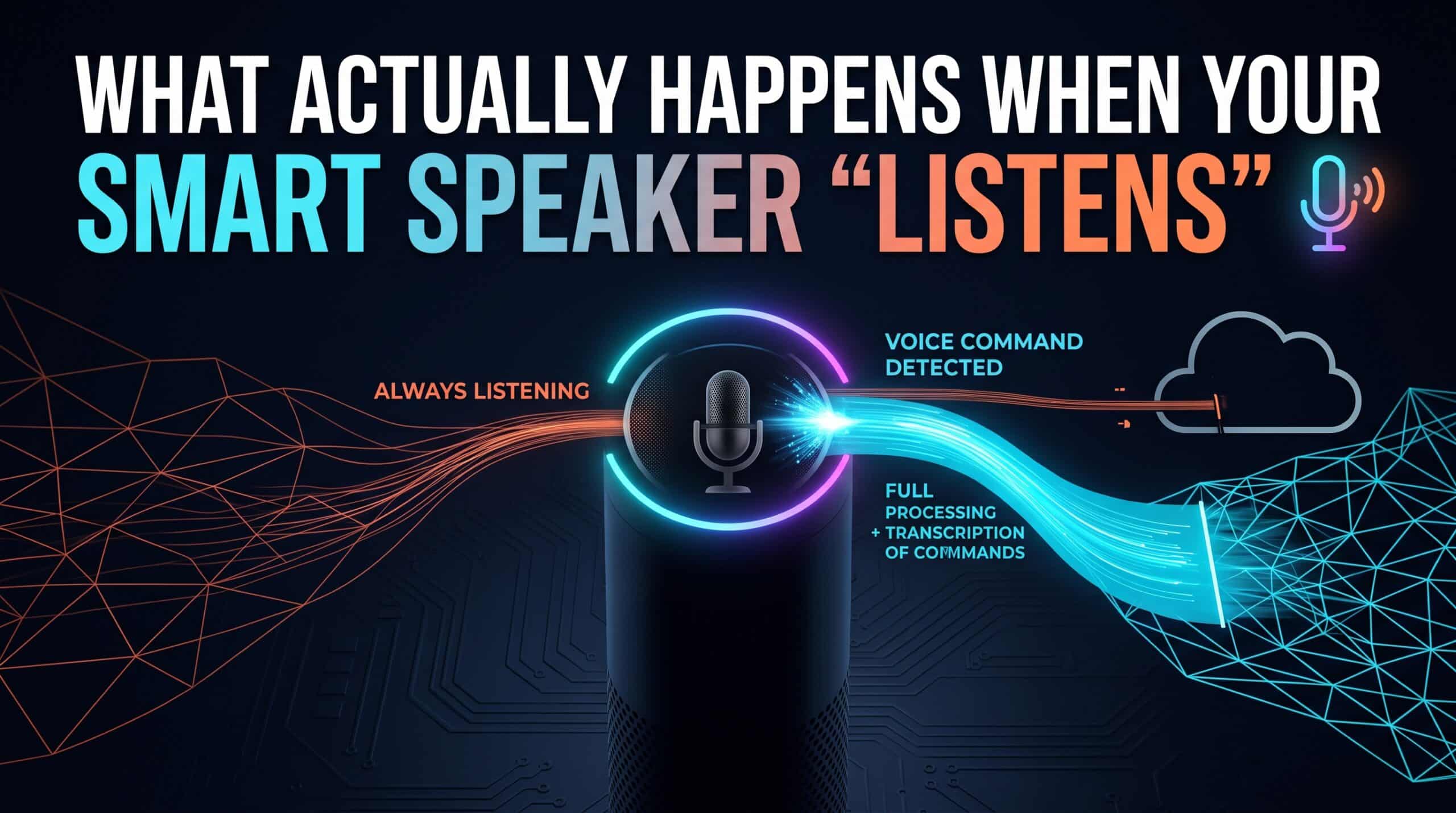
A smart speaker sitting quietly on a shelf, apparently always listening, raises a reasonable question: what is it actually doing with your household’s audio, and how much of that involves your internet connection at all? The honest, specific answer is more limited — and more locally-processed — than the vaguest privacy anxieties assume.
Local Processing, Most of the Time
Smart speakers are built to continuously listen for a specific wake word — “Alexa,” “Hey Google,” and similar — using processing that happens entirely on the device itself, locally, without sending anything over your network. This wake-word detection is deliberately lightweight and narrow, designed to recognize one specific short phrase rather than understand or transmit general conversation.
What Actually Triggers Real Network Activity
Only after the device detects its specific wake word does it begin actually streaming audio to the cloud for processing — the audio immediately following your wake word, sent as a short, bounded clip to be interpreted and answered. This is the point where real data usage begins, and it’s a deliberately narrow window, not a continuous, always-on data stream.
Why This Distinction Matters for Understanding Your Own Network
Because of this design, a smart speaker’s actual data usage is genuinely minimal in normal daily use — brief, bounded requests rather than a constant background stream. If you notice unusually high or continuous data usage attributed to a smart speaker specifically, that’s worth investigating as a potential anomaly rather than assumed as normal baseline behavior, since it doesn’t match how these devices are designed to operate under typical use.
Check your overall network usage and identify which devices are consuming meaningful bandwidth with our free speed test as a starting point for any deeper investigation.
Related Guides
Frequently Asked Questions
Is my smart speaker constantly sending audio to the cloud?
No. Wake-word detection happens locally on the device itself without using your network. Only the audio immediately following a detected wake word gets sent to the cloud as a short, bounded clip for processing — not a continuous stream.
What does it mean if my smart speaker seems to be using a lot of data?
That would be unusual given how these devices are designed to operate, with genuinely minimal, bounded data usage during normal use. Consistently high usage is worth investigating as a potential anomaly rather than assumed as expected behavior.