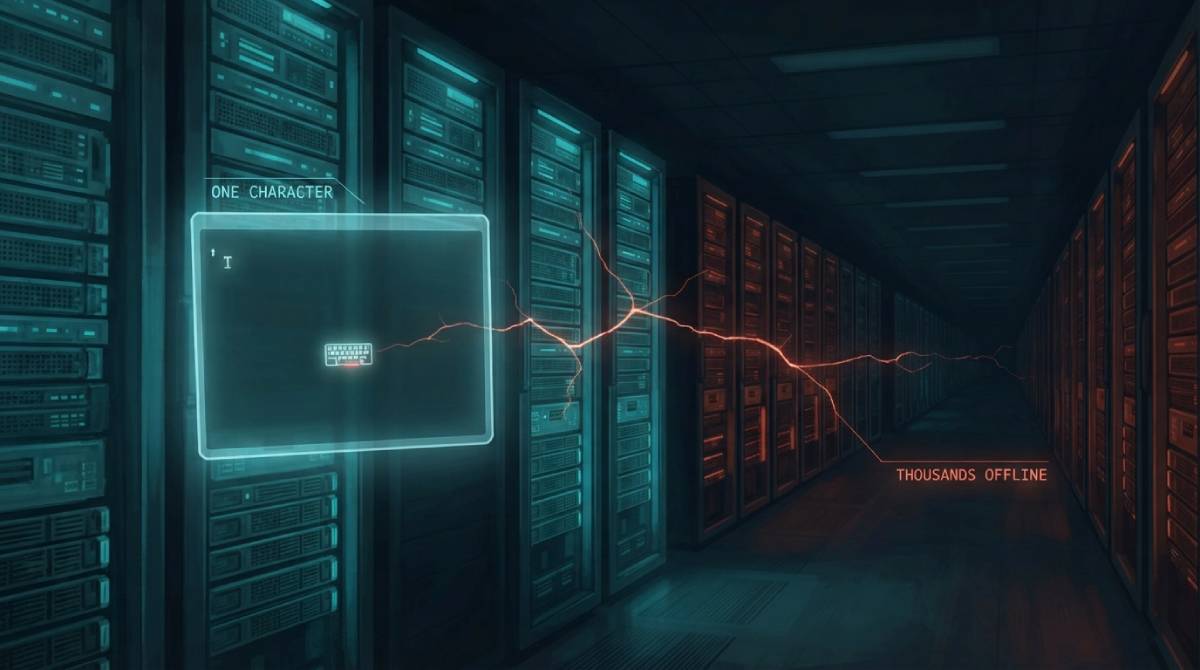
In February 2017, a large chunk of the internet quietly broke for several hours — websites failing to load, apps malfunctioning, services going dark — and the cause wasn’t a cyberattack, a natural disaster, or aging hardware. It was a single mistyped command, entered by one engineer during a routine debugging session at Amazon Web Services, that took far more servers offline than intended.
A Small Mistake With an Enormous Blast Radius
Amazon’s S3 storage service, a foundational piece of infrastructure that a huge number of websites and apps quietly depend on without most users ever realizing it, experienced a major outage after an authorized team member executed a command intended to remove a small number of servers for a specific subsystem. The command’s input was entered incorrectly, and it ended up removing a far larger set of servers than intended, cascading into a multi-hour disruption that rippled outward to every service built on top of that storage layer — a genuinely enormous share of the commercial internet, all traced back to a single typo.
Why This Story Matters Beyond One Company
This event is frequently cited in discussions of internet infrastructure specifically because it illustrates something easy to forget in daily use: an enormous portion of the internet runs on the same small number of foundational cloud providers, which means a single mistake at one of those providers can cascade far beyond that one company’s own services, into thousands of unrelated websites and apps that simply happen to depend on the same underlying infrastructure.
What This Means When You See a Widespread Outage
The next time an unusually large number of unrelated websites and services all seem to break at the same time, there’s a good chance the actual cause traces back to a shared piece of foundational infrastructure — not a coincidence of many separate companies failing independently, but a single point of concentrated dependency that most users never see until it briefly stops working.
If a major outage is affecting your ability to reach specific sites, your own connection may still be perfectly fine — confirm with our free speed test before assuming the problem is on your end.
Related Guides
Frequently Asked Questions
Can one small mistake really take down parts of the internet?
Yes — a well-documented 2017 incident at a major cloud storage provider was traced back to a single mistyped command during a routine debugging session, which removed far more servers than intended and caused a multi-hour outage affecting a huge number of dependent websites and apps.
Why do so many unrelated websites go down at the same time during these events?
A large portion of the internet runs on a small number of shared cloud infrastructure providers. When one of those providers has an issue, it can cascade into every website and service built on top of that shared infrastructure, even though those services are otherwise completely unrelated.