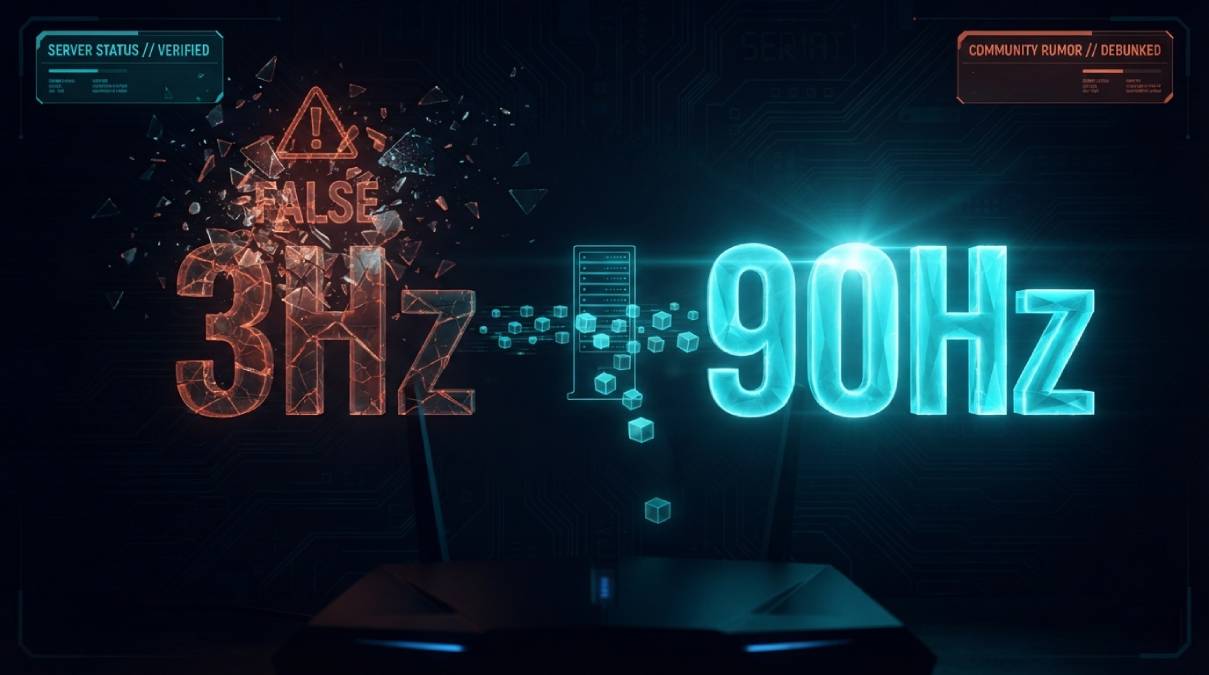
For a few days in November 2025, a number spread through the ARC Raiders community faster than any patch note: 3Hz. That’s the tick rate players were convinced Embark Studios’ servers were running on — a number so low it would make the game borderline unplayable, and a number that, if true, would have explained every stutter, every phantom hit, every moment of “I was clearly behind that wall” frustration players had been posting for weeks. It felt right. It matched what people were experiencing. The only problem was that it wasn’t true — and the real story turned out to be more interesting than the rumor.
Where a Made-Up Number Becomes Gospel
Nobody at Embark ever said “3Hz.” As far as anyone can trace it, the figure emerged from community speculation — someone doing rough math on observed desync, someone else repeating it as fact, and within days it had calcified into received wisdom across Discord servers and Reddit threads. That’s how a lot of technical rumors spread in gaming communities: a plausible-sounding number attaches itself to a real, felt problem, and the number becomes easier to share than the nuance underneath it. Embark eventually responded directly, with a developer stating flatly that the game “wouldn’t even run at 3Hz” — which is true. A tick rate that low wouldn’t produce laggy movement, it would produce something closer to a slideshow.
What Independent Testing Actually Found
The outlet The Escapist did what nobody in the rumor mill had bothered to do — they actually measured it. Their testing put ARC Raiders’ real tick rate at roughly 90Hz, which isn’t just “not 3Hz,” it’s genuinely high. For comparison, that’s more than double the tick rate Apex Legends runs at, and well above what most battle royale and extraction shooters ship with at launch. If tick rate alone determined how a game feels, ARC Raiders should have been one of the smoothest shooters of the year.
It wasn’t. And that’s the part the “3Hz” rumor accidentally got right, even while getting the mechanism completely wrong.
| Claim | What It Suggested | What Was Actually True |
|---|---|---|
| “Servers run at 3Hz” | Game should be nearly unplayable | False — game runs normally, this number was never real |
| Embark’s response | Denial without explanation | Confirmed the rumor was false, without yet explaining the real desync |
| Independent testing (The Escapist) | Needed real measurement, not speculation | ~90Hz — among the highest tick rates in the genre |
| Ongoing desync reports | Assumed to be a tick rate problem | Traced to UDP packet loss on the backend, unrelated to tick rate |
A High Tick Rate Doesn’t Fix a Leaky Pipe
Here’s the part that actually matters if you want to understand your own connection, not just this one controversy. Tick rate measures how often a server updates the game world — 90 times a second, in ARC Raiders’ case. It says nothing about whether every one of those updates actually survives the trip to your screen intact. Player movement data in most shooters, including this one, travels over UDP, a protocol that prioritizes speed over guaranteed delivery. If a packet carrying your position gets dropped somewhere along the way, UDP doesn’t resend it — it just moves on. The server never got the update, so it renders you where it last knew you to be, not where you actually are. That’s the gap between “I was behind cover” and “the server shot me anyway,” and it has nothing to do with how many times per second the server ticks.
Embark has since acknowledged broader backend instability since launch and rolled out server queuing and compensation changes while they keep investigating. It’s a live, evolving fix — not a settings toggle players can flip on their end.
The Actual Lesson
The 3Hz story is a small case study in something bigger: a high, healthy tick rate and a genuinely broken-feeling connection can coexist, because they’re measuring different failure points entirely. One is about how often the server thinks. The other is about whether what you’re sending actually arrives. If you’re troubleshooting your own connection in any online game — not just this one — checking your ping is only half the picture. Packet loss is the part most players never think to look at, because most tools never show it to them.
You can check both, live, for ARC Raiders specifically at our ARC Raiders ping test — it tests your latency across every major region and gives you the real numbers instead of community folklore. If you want a deeper read specifically on packet loss and what causes it, see our packet loss explainer.
Related Guides
- Gamer Hub — All Game Ping Tests
- ARC Raiders Ping Test
- General Server Ping Test
- What Causes Packet Loss?
- Jitter vs Ping for Gaming
- What Is a Good Ping for Gaming?
Frequently Asked Questions
Does ARC Raiders really run on 3Hz servers?
No. That number was never real — it was a community-originated figure, not something Embark ever stated. Embark directly denied it, and independent testing from The Escapist measured the actual tick rate at roughly 90Hz, one of the higher rates in the genre.
If the tick rate is fine, why does the game still feel laggy sometimes?
Embark has attributed ongoing desync issues to backend and packet-loss problems, not tick rate. A high tick rate means the server updates frequently — it doesn’t guarantee every movement packet sent over UDP actually arrives, which is a separate, real issue the studio is actively patching.