When Mortal Kombat 1 launched, one of the loudest complaints wasn’t about a character or a combo — it was about something most players couldn’t even define precisely, but could absolutely feel. Matches that should have felt instant felt underwater. Grabs that connected on screen suddenly reversed mid-animation. Players who’d spent years on Street Fighter 6, a game widely praised for how “clean” its online felt, found MK1 jarring by comparison. The word everyone reached for was netcode. Almost nobody agreed on what that actually meant.
Two Ways to Solve the Same Problem
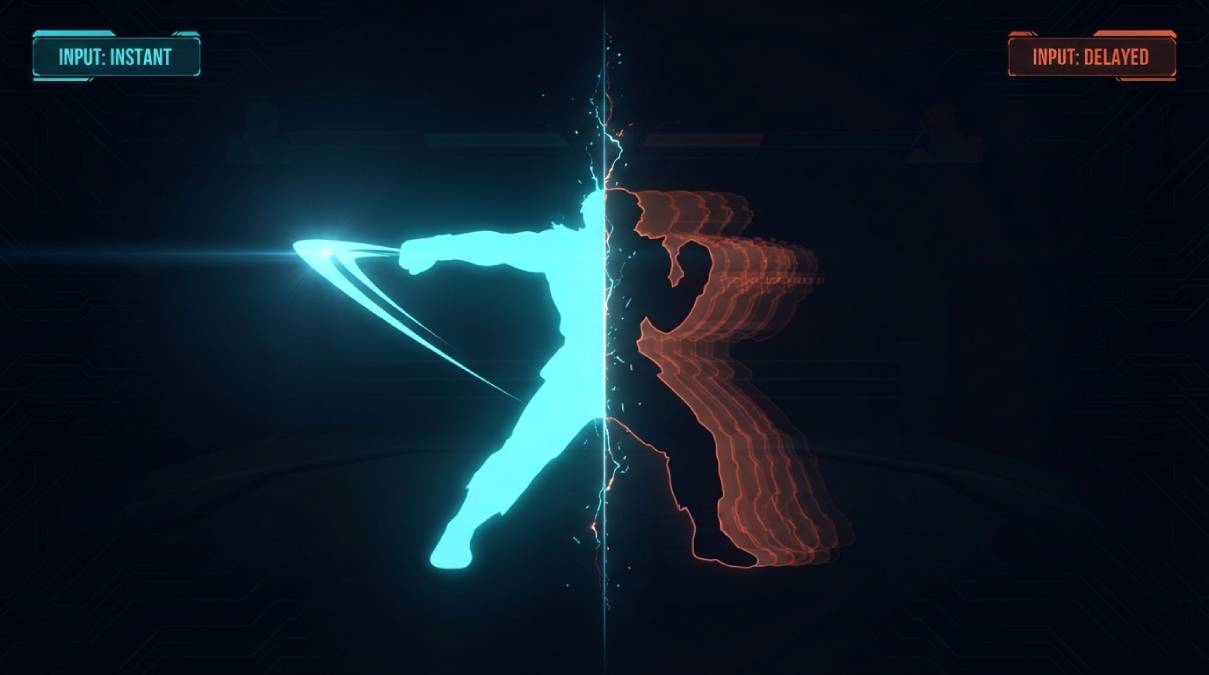
Every online fighting game has to solve one unavoidable problem: two players, two locations, and a network connection between them that takes time to cross. If Player A punches and Player B blocks, both computers need to agree on what happened — but the punch and the block don’t arrive on each machine at the same instant. For years, the industry’s default answer was delay-based netcode: hold every input back by a few frames, long enough that your opponent’s input has time to arrive, then process both together. It’s fair, predictable, and it feels exactly like pressing a button through a small layer of mud. At 100ms of round-trip latency, that’s roughly 3-4 frames of pure added delay before your character reacts at all.
Rollback netcode, popularized by Tony Cannon’s GGPO library, takes the opposite approach. Instead of waiting, your local inputs process instantly, as if you were playing offline. The game predicts what your opponent is doing based on their last known input, and if that guess turns out wrong once the real data arrives, the game silently rewinds a few frames and replays the correct outcome. Done well, this is close to magic — your own inputs never feel delayed, no matter how bad the connection gets. Done poorly, you get exactly what MK1 players were describing: grabs that reverse mid-cinematic, moves that appear to hit and then don’t.
Why “Does It Have Rollback?” Became the First Question
The fighting game community fought for close to a decade to get rollback adopted industry-wide, and for good reason — the difference in feel is large enough that community consensus has settled on something close to a rule of thumb: a game with good rollback at 100ms ping plays better than a game with delay-based netcode at 30ms. That’s not a small gap. It’s the difference between a punish window that’s actually reactable and one that isn’t, and it’s why every fighting game announcement now gets picked apart for a single detail before anything else is discussed.
But rollback isn’t free. It costs real engineering complexity, since the game engine has to be able to resimulate several frames of game state within a single render frame’s time budget — often under 2 milliseconds of CPU headroom to rewind and replay up to a dozen frames. Games with heavier simulations, more complex physics, or 3D character animation (where a sudden rewind produces a visibly jarring snap rather than a clean 2D sprite swap) have a much harder time implementing it well. Tekken producer Katsuhiro Harada has spoken directly about this — 3D fighters see much more visually jarring rollback moments than 2D games do, because the animations flow continuously from input to completion instead of holding on discrete poses.
What This Means the Next Time You Load Into a Match
If a match feels sluggish and heavy, that’s usually delay-based netcode doing exactly what it’s designed to do — adding deliberate input delay to keep things fair. If a match feels smooth but occasionally does something visually strange — a combo that appeared to connect, then didn’t — that’s very likely rollback doing a correction you’re seeing happen in real time. Neither one means your internet connection is broken. What actually determines how much either style punishes you is the same thing that matters in every other online game: your ping and how stable it stays, since both netcode styles are trying to paper over the same underlying latency, just with different tradeoffs.
Testing your actual connection quality before a competitive session is still the one variable you fully control — you can check your live latency across every major region at our general server ping test, or if you’re deciding between platforms for a specific title, run our Gamer Speed Test for a full readout including jitter, which matters even more in a rollback game than raw ping alone.
Related Guides
- Gamer Hub — All Game Ping Tests
- General Server Ping Test
- Gamer Speed Test
- Jitter vs Ping for Gaming
- What Is a Good Ping for Gaming?
Frequently Asked Questions
Is rollback netcode always better than delay-based netcode?
For most competitive players, yes — the elimination of input delay is significant enough that community consensus favors rollback even at noticeably higher ping. But rollback is harder to implement well, especially in 3D games with continuous animation, so a poorly implemented rollback system can feel worse than a clean, well-tuned delay-based one.
Can I tell which netcode style a game is using just by playing it?
Often, yes. Delay-based netcode tends to feel like a consistent, uniform lag on your own inputs regardless of what’s happening on screen. Rollback tends to feel snappy most of the time, with occasional visible “correction” moments — a move reversing, a position snapping — especially as ping rises.