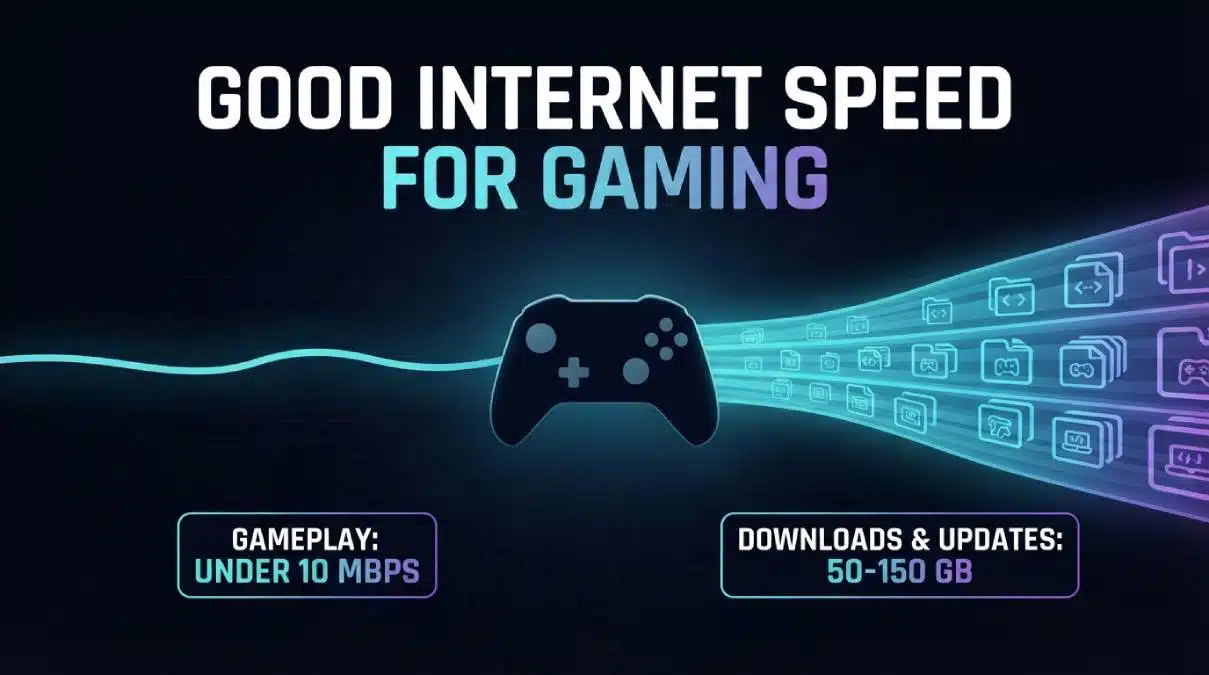
Online gaming has one of the biggest gaps between perceived and actual bandwidth needs of any common household activity. Most competitive multiplayer games use well under 10 Mbps during actual play, which surprises players who assume gaming demands the highest tier of internet plan available.
What Gameplay Itself Actually Needs
Real-time multiplayer games send small packets of position and action data, not large continuous streams, which is why actual in-match bandwidth usage typically stays under 10 Mbps even for fast-paced competitive shooters. What matters far more than raw speed for the actual gameplay experience is ping and jitter, since those directly determine how responsive the game feels moment to moment.
Where the Bigger Numbers Actually Come From
Game downloads and updates are the real source of gaming’s bandwidth reputation — modern AAA titles frequently install at 50 to 150 GB, and major live-service game updates can exceed 20 GB on their own. A faster connection genuinely helps here, cutting a multi-hour download into a much shorter wait, even though it does nothing to improve the actual in-game feel once you are playing.
Recommended Speeds by Household
A single gamer is comfortably served by 25 to 50 Mbps for smooth gameplay, with faster speeds mainly benefiting download times. A household with multiple simultaneous gamers, or gaming alongside 4K streaming, benefits from 100 to 300 Mbps to keep every activity running smoothly at once without one activity crowding out another.
Check your actual ping and speed for your specific game with our Gamer Hub ping tests.
Related Guides
- What Is a Good Ping for Gaming?
- Why Some Games Punish High Ping More Than Others
- Is 50 Mbps Good for Gaming?
Frequently Asked Questions
Do I need gigabit internet for gaming?
No — actual gameplay uses well under 10 Mbps for most games. Faster plans mainly help with game download and update times, not the in-game experience itself.
What matters more than speed for gaming?
Ping and jitter matter far more than raw speed for how responsive a game feels. A stable, low-ping connection outperforms a faster but inconsistent one for actual gameplay.