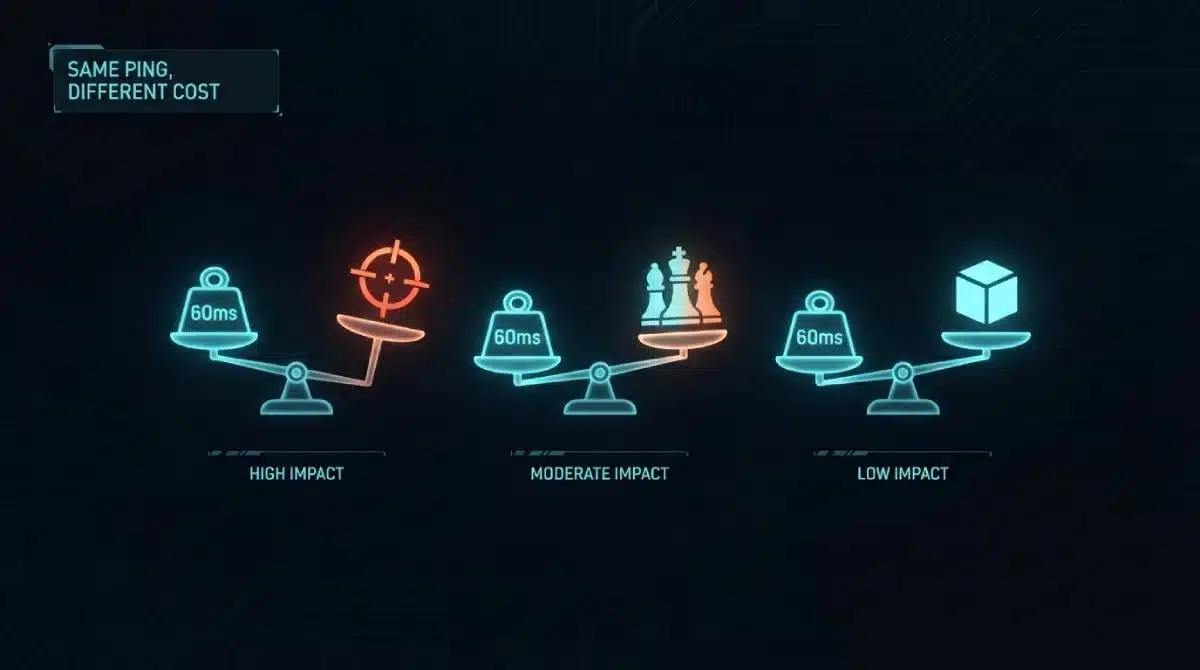
Ask ten players what “good ping” means and you’ll likely get ten similar-sounding answers, all revolving around getting the number as low as possible. But the same 80 milliseconds of ping that’s a mild inconvenience in one game can be a genuine, rank-limiting handicap in another. Ping isn’t a fixed-impact number — its real-world cost depends entirely on what kind of game you’re pointing it at.
The Games Where Milliseconds Decide Everything
Tactical shooters sit at the extreme end of ping sensitivity. Valorant’s 128-tick servers update player positions every 7.8 milliseconds — at 15ms ping, your inputs land within about two server ticks of sending them, functionally real-time. At 60ms, inputs can register 7 to 8 ticks late, creating a real, measurable peeking disadvantage against an opponent with lower ping. Rocket League sits in a similar bracket for a completely different reason — its deterministic physics mean any desync between your client and the server produces visible, immediate consequences in precision mechanics like flip resets, where the timing windows are measured in single-digit milliseconds.
The Games Where Ping Matters, But Differently
MOBAs and MMOs occupy a meaningfully different position. League of Legends and Dota 2 both run at roughly 30Hz — noticeably lower than a tactical shooter’s tick rate — but the games themselves aren’t built around split-second twitch aim. Ping still matters enormously for skillshot timing and reaction-based plays, but the margin for a “playable” experience is wider, since the fundamental skill expression relies less on frame-perfect precision and more on decision-making, positioning, and game sense that a slightly higher ping doesn’t erase.
The Games Where Ping Barely Registers at All
At the other end sits something like Minecraft’s standard survival multiplayer, or turn-based and slower-paced titles, where the actual gameplay loop simply doesn’t demand split-second precision from your connection in the first place. A 100ms ping that would be a genuine liability in Valorant is nearly unnoticeable in casual Minecraft building or exploration, because nothing in that experience is timed tightly enough for the difference to register.
What This Means for Where You Spend Your Effort
The practical lesson is that “good ping” isn’t a universal target — it’s a target relative to what you’re actually playing. Chasing sub-20ms for casual Minecraft sessions is effort spent on a number that won’t change your experience. Chasing exactly that same number for competitive Valorant or Rocket League is directly, measurably worth the effort, because those games are specifically built to reward it.
Compare your own live ping across different game types with our Gamer Hub — testing the specific title you care about tells you far more than a generic connection check ever will.
Related Guides
- Gamer Hub — All Game Ping Tests
- Valorant Ping Test
- League of Legends Ping Test
- Minecraft Ping Test
- What Is a Good Ping for Gaming?
Frequently Asked Questions
Why does the same ping feel fine in one game and bad in another?
Because different games have different tick rates and different mechanical demands. A tactical shooter with a 128-tick server and split-second peeking mechanics is far more sensitive to a given ping value than a turn-based or casual-paced game where nothing depends on frame-perfect timing.
Is it worth optimizing my connection for casual games too?
It depends on the game. For slower-paced or casual titles, the practical difference between 20ms and 80ms ping is often barely noticeable. For competitive, high-tick-rate, or physics-precise games, that same gap can be a real, measurable disadvantage worth actively addressing.