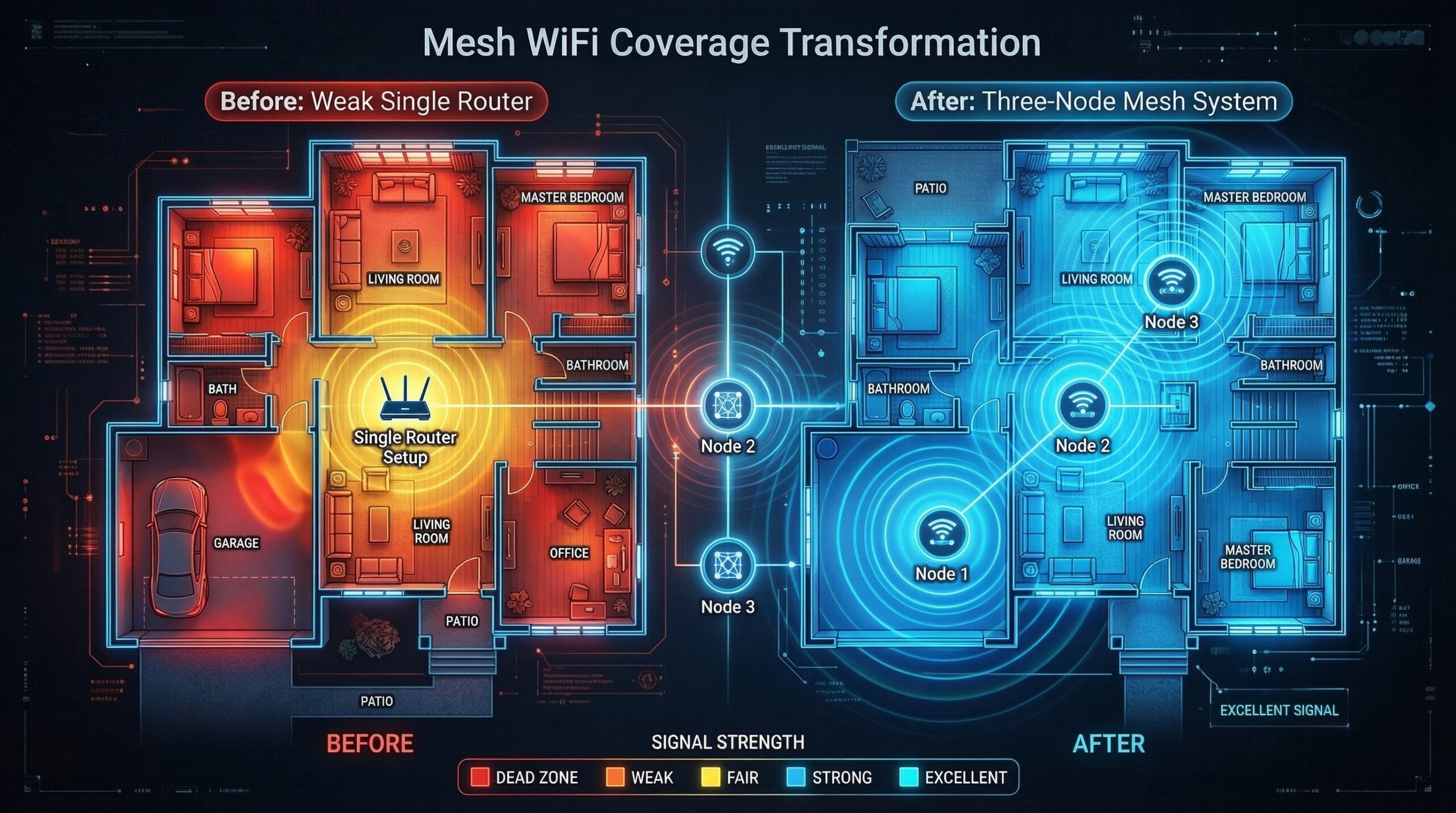
How to Improve WiFi in a Large House — Every Option Compared
A single router can typically cover 1,500–2,000 sq ft with good signal. Beyond that — or in homes with multiple floors, thick walls, or unusual layouts — you need additional coverage hardware. Test your worst-coverage spot at instantspeedtest.net/ and compare to near-router speeds to quantify the problem.
Coverage Solutions — Compared by Cost, Performance, and Complexity
| Solution | Best For | Speed Loss | Cost | Setup |
|---|---|---|---|---|
| Router repositioning | Minor coverage gaps | None | Free | Trivial |
| WiFi extender / repeater | Single dead zone | 50% on extended band | $20–60 | Easy |
| Powerline adapter | Wired backhaul through walls | Variable (electrical wiring quality) | $50–100 | Easy |
| MoCA adapter | Homes with coax wiring | Minimal | $80–150 | Moderate |
| Mesh WiFi system | Whole-home seamless coverage | Minimal with tri-band | $150–400 | Easy |
| Wired access points | Best performance, any size home | None (wired backhaul) | $80–200 per AP | Complex (cable runs) |
Mesh WiFi vs WiFi Extenders — Why Mesh Wins for Large Homes
WiFi extenders (repeaters) create a separate network name and use the same radio band for both client connections and backhaul to the main router — halving available bandwidth. They also require manual device switching between networks. Mesh systems use a dedicated backhaul channel (or wired backhaul) and present a single network name, seamlessly roaming devices between nodes. For homes over 2,000 sq ft, mesh is dramatically better than extenders. See our full explanation in the mesh WiFi guide.
Related Guides
- What Is a Mesh WiFi System?
- Does Router Placement Affect Speed?
- How to Boost WiFi Signal
- WiFi 6 vs WiFi 5
- How Many Devices Can Connect to WiFi?
- 2.4 GHz vs 5 GHz WiFi
Frequently Asked Questions
How many mesh nodes do I need for a 3,000 sq ft house?
Typically 2–3 nodes depending on layout. A simple rectangular two-story home: 2 nodes (one per floor). A sprawling single-story with many rooms: 3 nodes. Tri-band mesh systems (like Eero Pro 6E, Orbi, or Google Nest WiFi Pro) handle 3,000 sq ft well with 2 nodes when placed centrally on each floor. Open floor plans need fewer nodes than compartmentalized layouts.
Will a WiFi extender halve my speed?
On a single-band extender — yes, roughly 50% reduction is expected because the extender uses the same radio to communicate with both your router and your devices. Dual-band extenders improve this by using one band for backhaul and another for clients. Tri-band or wired backhaul mesh eliminates this problem entirely. For a dead zone where any coverage is better than none, even a halved speed improvement is worthwhile.