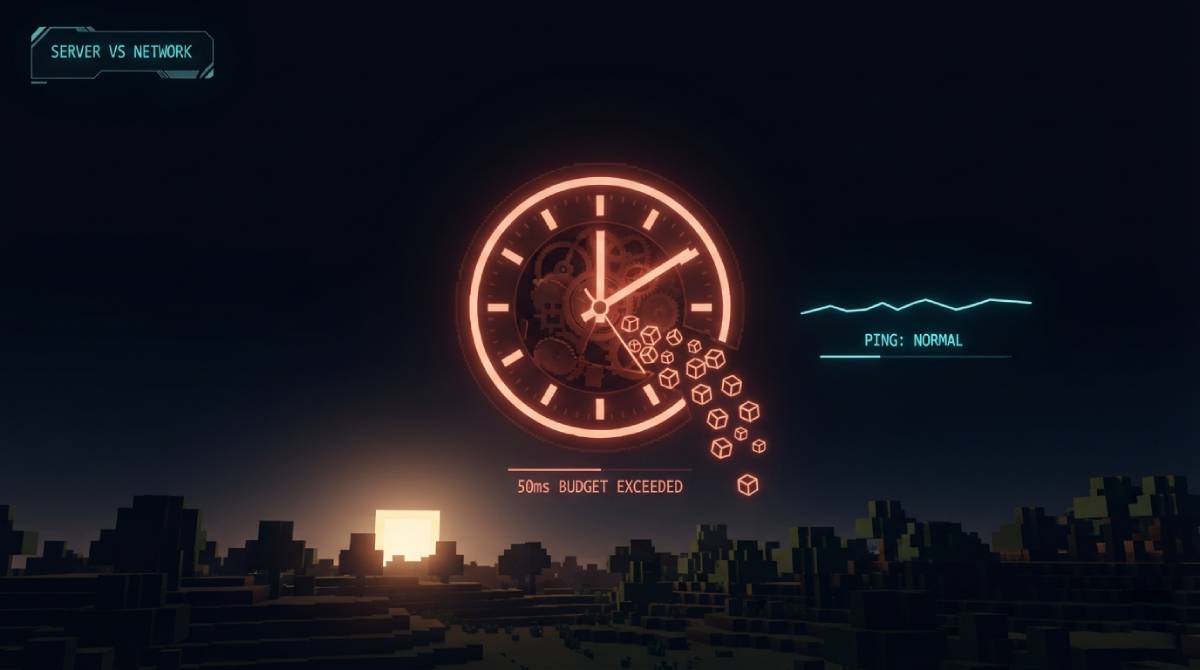
Of every game covered on this site, Minecraft has the strangest relationship with the word “lag,” because most of the time, the thing players call lag has nothing to do with the internet at all. Minecraft’s servers run a fixed 20 ticks per second — one tick every 50 milliseconds — and that single number governs literally everything happening in the world simultaneously: mob AI, redstone circuits, block updates, crop growth, the day-night cycle, for every player at once.
A Budget the Server Can Blow
Every tick, the server has exactly 50 milliseconds to process everything happening in currently loaded chunks. Too many active mobs, a complex redstone contraption looping continuously, hoppers constantly scanning for items, or too many entities crammed into a small space can all push a single tick past that 50ms budget. When that happens repeatedly, the server falls behind its own schedule, and if the backlog stretches past roughly 2000 milliseconds, players see the well-known “Can’t keep up!” warning — a pure server-side computation problem, and one that no amount of personal internet improvement touches.
How to Actually Tell the Difference
This distinction matters practically, because the fix is completely different depending on which kind of lag you’re experiencing. If a server feels laggy for absolutely everyone at once, regardless of each individual player’s own connection, that’s a TPS (ticks per second) problem — the server itself is falling behind its computation schedule, and the fix lives on the server’s end: reducing mob farms, optimizing redstone, or upgrading hardware. If it’s laggy specifically for you while other players on the same server report smooth play, that points to your own ping and connection instead.
Where Your Own Ping Actually Does Matter
None of this means your connection is irrelevant in Minecraft — it matters for how responsive block breaking, movement, and combat feel to you personally, and it matters considerably more on PvP-focused servers where hit registration and reach are time-sensitive. The key insight is just separating two genuinely different problems that both get called “lag” by players who haven’t had a reason to distinguish them before: TPS is a server-side simulation budget with a hard 50ms ceiling per tick, and ping is your personal round-trip time to that server, and they’re independent enough that a server can run a perfect 20 TPS while you personally have terrible ping, or the reverse.
Test your own connection to major regions with our Minecraft ping test, and if a specific server consistently feels slow for everyone, that’s worth raising with the server admin rather than troubleshooting your own setup.
Related Guides
- Gamer Hub — All Game Ping Tests
- Minecraft Ping Test
- Roblox Ping Test
- Gamer Speed Test
- What Is a Good Ping for Gaming?
Frequently Asked Questions
Is Minecraft’s TPS the same thing as ping?
No. TPS measures how fast the server’s own simulation loop is running, ideally a steady 20, and it affects every player on the server equally regardless of their individual connection. Ping measures your personal round-trip time to that server — they’re independent metrics.
Why does my Minecraft server lag even though everyone has good internet?
This is almost always a server-side tick budget problem, not a network issue. Large mob farms, complex redstone circuits, and too many loaded chunks can all push the server past its 50-millisecond-per-tick processing budget, which no amount of personal ping improvement will fix.