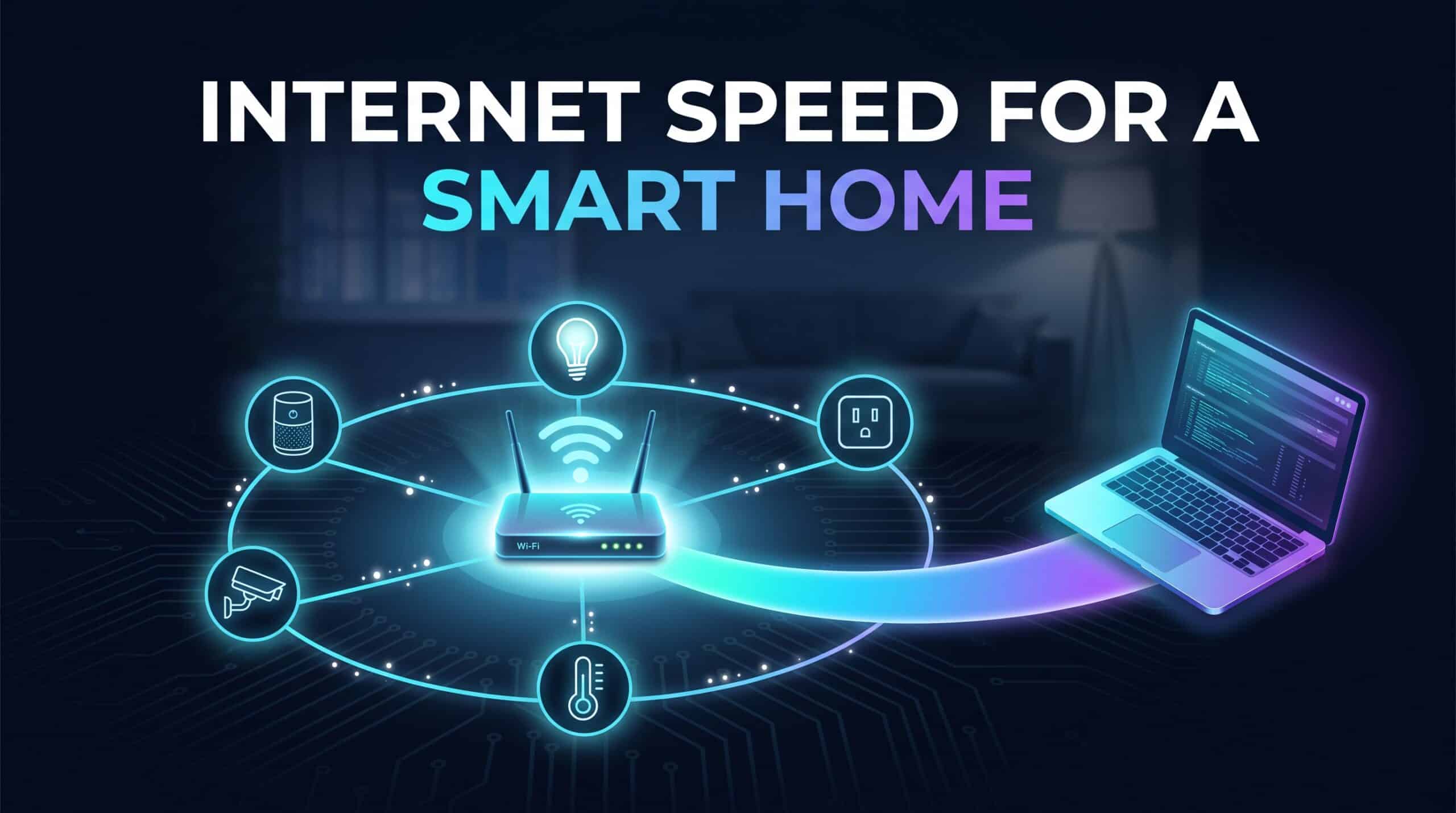
A smart home’s internet requirements are shaped less by raw bandwidth demand and more by how many devices are simultaneously connected, since most individual smart home devices use very little data on their own.
Why Individual Devices Barely Register
A smart bulb, plug, or sensor typically uses only a small trickle of data, mostly periodic check-ins to confirm it is still connected and responsive. Even video-capable devices like smart doorbells and cameras, which use meaningfully more, still represent a modest total load compared to something like 4K streaming.
Where the Real Requirement Comes From
The genuine constraint in a smart home is less about total bandwidth and more about your router’s ability to handle many simultaneous connections gracefully, since WiFi is a shared medium where every device, however light its actual data usage, still consumes a small amount of airtime maintaining its connection. A modest 25 to 50 Mbps plan comfortably supports the bandwidth needs of dozens of smart devices; what actually starts to strain a network is device count itself on a lower-end router not built for high-density environments.
What Actually Helps a Growing Smart Home
A router supporting WiFi 6 or WiFi 6E specifically improves handling of many simultaneous low-bandwidth devices through more efficient channel access technology, a meaningfully bigger factor than raw internet speed for a smart-home-heavy household. Splitting devices across the 2.4GHz and 5GHz bands, with low-bandwidth smart devices on 2.4GHz, also reduces contention as your device count grows.
Check your network’s real performance as your smart home grows with our free speed test.
Related Guides
- How Many Smart Devices Your WiFi Can Actually Handle
- WiFi 6 vs WiFi 5 Speed Difference
- 2.4GHz vs 5GHz WiFi
Frequently Asked Questions
Do I need fast internet for a smart home?
Not particularly — most smart home devices individually use very little bandwidth. Router quality and its ability to handle many simultaneous connections matters more than raw internet plan speed.
What actually strains a smart home network?
Device count on a lower-end router built for a smaller number of connections, not total bandwidth demand, is usually the real constraint as a smart home grows.