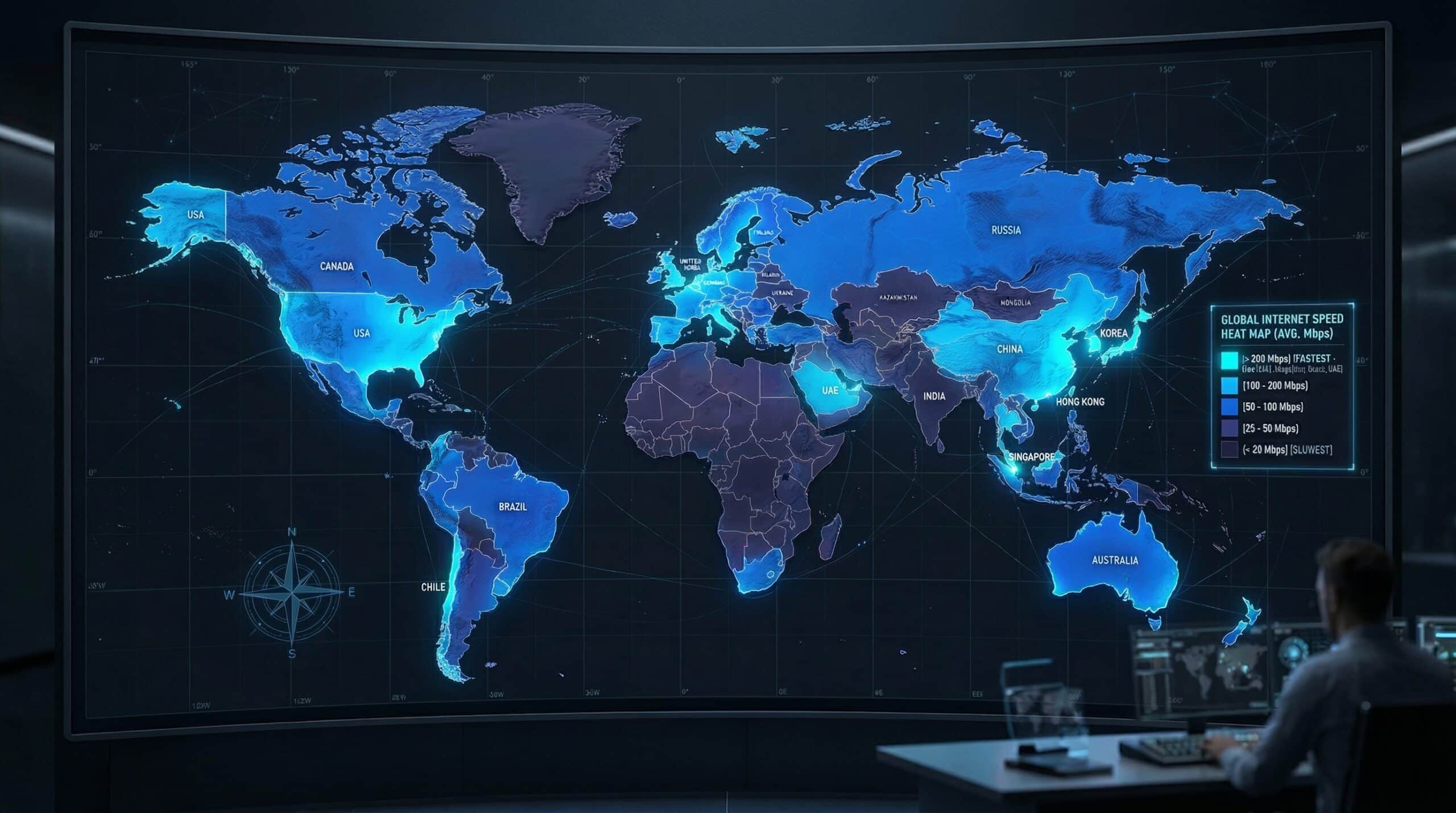
Average Internet Speed by Country — 2025 Global Rankings
Internet speeds vary dramatically by country — from over 300 Mbps average in leading nations to under 5 Mbps in the slowest-connected regions. These rankings are based on fixed broadband median download speeds from global speed test aggregate data. Test your speed at instantspeedtest.net/ and see how you compare.
Top 15 Fastest Countries — Average Fixed Broadband Speed
| Rank | Country | Avg Download (Mbps) | Primary Technology |
|---|---|---|---|
| 1 | Singapore | 300+ | Fiber (90%+ coverage) |
| 2 | Hong Kong | 290+ | Fiber |
| 3 | South Korea | 270+ | Fiber |
| 4 | UAE | 250+ | Fiber |
| 5 | Denmark | 220+ | Fiber |
| 6 | Switzerland | 210+ | Fiber + Cable |
| 7 | Romania | 200+ | Fiber |
| 8 | Norway | 195+ | Fiber + Cable |
| 9 | USA | 185+ | Cable + Fiber |
| 10 | Japan | 180+ | Fiber |
| 11 | Netherlands | 175+ | Cable + Fiber |
| 12 | Sweden | 170+ | Fiber |
| 13 | UK | 160+ | Cable + Fiber |
| 14 | Germany | 100+ | Cable + DSL |
| 15 | India | 80+ | Fiber + Cable |
Why Fiber Penetration Drives National Rankings
The correlation between fiber internet deployment and national speed rankings is nearly perfect. Singapore, South Korea, and the UAE achieved dominant positions through government-mandated or heavily subsidized nationwide fiber rollouts. The US and UK rank below their wealth levels because cable (DOCSIS) infrastructure remained dominant for longer — cable’s asymmetric speeds drag down national averages compared to fiber-dominant nations. See our fiber vs cable comparison for why fiber produces fundamentally better speeds.
Related Guides
- Fiber vs Cable Internet
- What Is Fiber Internet?
- What Is a Good Download Speed?
- Is 200 Mbps Good Internet Speed?
- What Is T-Mobile Home Internet Speed?
- 4G vs 5G Speed
Frequently Asked Questions
Which country has the fastest internet in the world?
Singapore consistently ranks #1 for fixed broadband speed with median speeds over 300 Mbps, driven by near-universal fiber coverage and a compact geography that makes dense fiber deployment economically efficient. For mobile internet speed, the UAE and South Korea often lead global rankings as early 5G deployers with high smartphone adoption.
Why is Germany’s internet speed relatively low for a rich country?
Germany’s speed lagging behind smaller European nations reflects late fiber investment and heavy reliance on legacy DSL (copper telephone) infrastructure. DSL was deployed nationwide efficiently decades ago, reducing the urgency for expensive fiber replacement. Germany began significant fiber expansion in 2020–2024. Internet speed reflects infrastructure investment decisions made 10–20 years earlier more than current economic wealth.