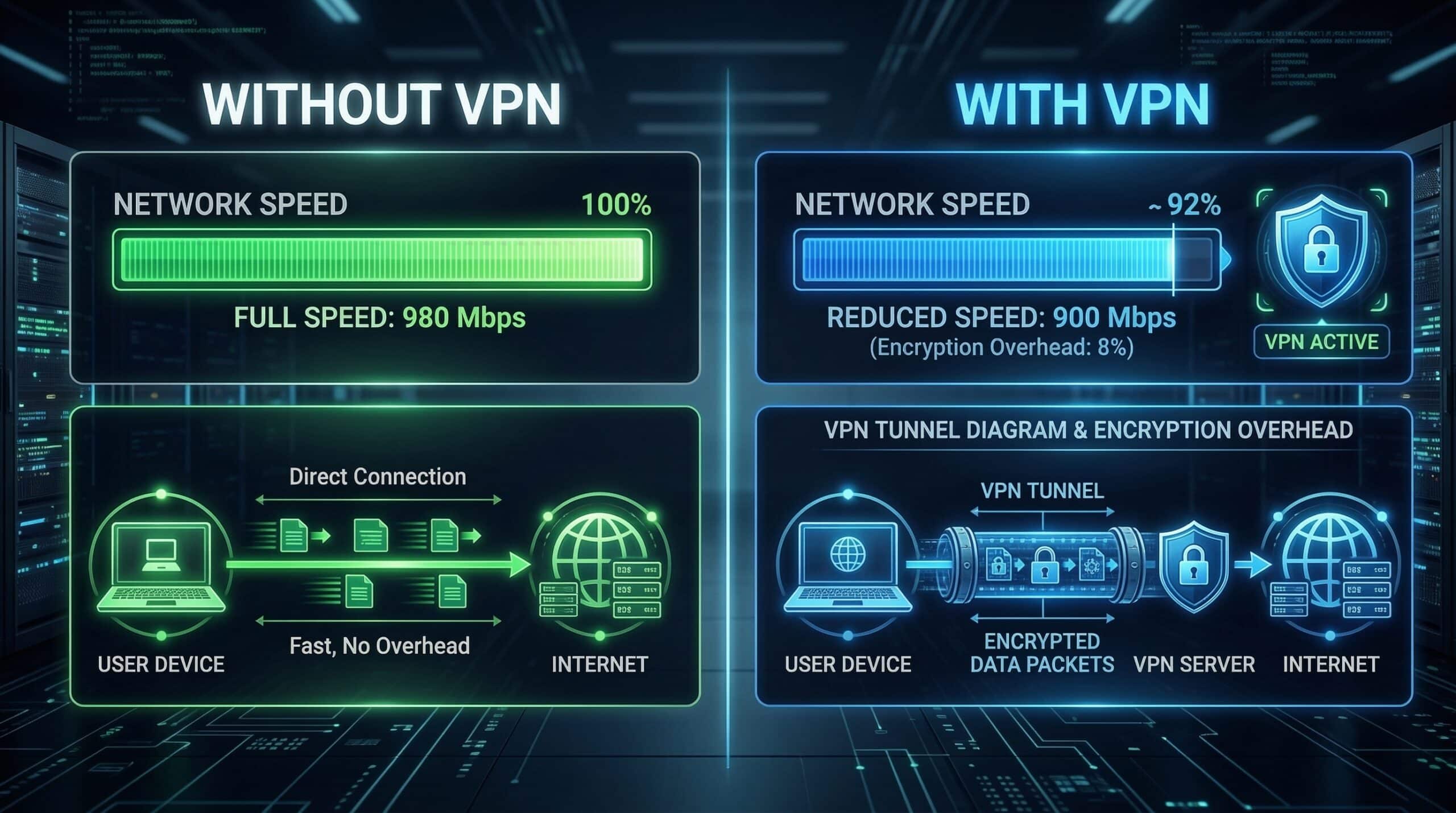
Does a VPN Slow Down Your Internet Speed? Honest Answer
Yes — VPNs always add some speed reduction due to encryption overhead and server routing. The real question is how much. Test your speed without VPN at instantspeedtest.net/, then test again with VPN active to measure your specific VPN’s impact.
VPN Speed Impact — By VPN Quality and Protocol
| VPN / Scenario | Speed Reduction | Latency Addition |
|---|---|---|
| Premium VPN, nearby server, WireGuard | 5–15% | 2–10ms |
| Premium VPN, nearby server, OpenVPN | 15–30% | 5–20ms |
| Premium VPN, distant server | 20–40% | 30–100ms |
| Free VPN (bandwidth throttled) | 60–90% | 50–200ms |
| Corporate VPN, full tunnel | 20–40% | 20–60ms (depends on server location) |
Why VPNs Slow Speed — The Technical Reasons
Three factors cause VPN speed reduction: (1) Encryption overhead — your device must encrypt every outgoing packet and decrypt every incoming packet. Modern protocols (WireGuard) are dramatically more efficient than older protocols (OpenVPN, L2TP). (2) Server distance — VPN routes all traffic through a VPN server. If that server is 5,000 km away, every packet travels 10,000 km round-trip instead of directly to the destination. (3) Server congestion — free and low-cost VPNs overload their servers, creating bottlenecks. Using a nearby server on a premium VPN with WireGuard protocol typically reduces VPN speed impact to under 10%.
Related Guides
- How to Check If ISP Is Throttling
- Fix Gaming Lag Without VPN
- What Is Latency?
- Good Internet Speed for Working From Home
- Download Speed Slower Than Plan
- Best DNS Servers for Speed
Frequently Asked Questions
Which VPN protocol is fastest?
WireGuard is the fastest VPN protocol — modern cryptography and lean codebase deliver speeds within 5–15% of unencrypted connections. ExpressVPN’s Lightway protocol and NordVPN’s NordLynx are WireGuard-based. OpenVPN is slower but more widely supported. L2TP/IPSec and PPTP are older, often slower, and less secure. If your VPN supports WireGuard, use it.
Can a VPN ever make internet faster?
In one specific case: if your ISP throttles certain traffic types (Netflix, gaming) and a VPN hides that traffic classification, VPN speeds may be faster for those specific services. This is confirmation of ISP throttling rather than VPN improving your connection. Outside of this scenario, a VPN cannot exceed your base connection speed — it can only approach it with minimal overhead.