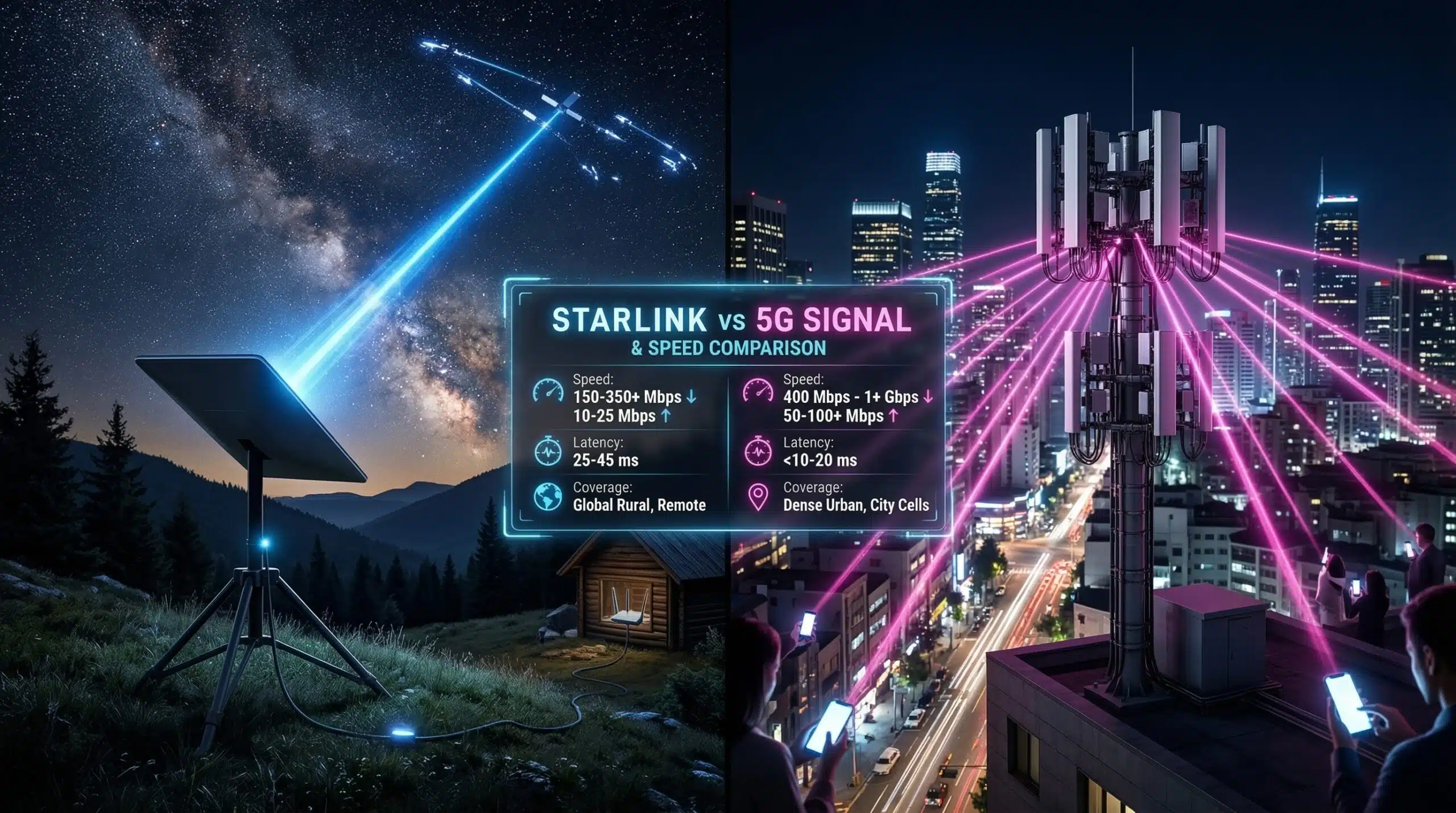
Starlink vs 5G Home Internet — Which Should You Choose?
Both Starlink and 5G home internet are wireless broadband solutions designed for areas underserved by cable and fiber. They deliver genuinely fast internet without requiring cables to your home — but they work very differently and have distinct strengths and weaknesses. Use our speed test to benchmark whichever you currently have.
Head-to-Head Comparison
| Feature | Starlink | 5G Home Internet (T-Mobile/Verizon) |
|---|---|---|
| Download Speed | 50–250 Mbps | 72–300 Mbps |
| Upload Speed | 10–20 Mbps | 15–50 Mbps |
| Latency | 20–60ms | 20–50ms |
| Data Cap | Unlimited (deprioritized above 1 TB) | Unlimited (managed) |
| Monthly Cost | $120 (Standard) / $250 (Priority) | $50–60/month |
| Equipment Cost | $299–599 (one-time) | Free (included) |
| Availability | Global (where sky visible) | 5G coverage areas only |
| Weather Sensitivity | Moderate | Low–Moderate |
Where 5G Home Internet Wins
5G home internet (especially T-Mobile’s offering) is significantly cheaper — $50–60/month vs Starlink’s $120+. Where 5G mid-band coverage is strong, speeds match or exceed Starlink with comparable latency. Self-install is simpler (just plug in the gateway); no dish alignment required. For households in the coverage area of strong mid-band 5G, 5G home internet delivers better value. T-Mobile’s network now covers over 300 million people with 5G, making it available to most suburban and many rural US households. For details on T-Mobile’s specific performance, see our guide on T-Mobile Home Internet speeds.
Where Starlink Wins
Starlink’s coverage is truly global — it works in extremely remote locations, on farms, in mountains, in developing countries, and anywhere with a clear sky. Where 5G coverage is weak or absent, Starlink is the clear choice. Starlink also shows more consistent performance in truly rural areas where the nearest 5G tower is distant. For maritime, aviation, and emergency response use cases, Starlink has portable options that 5G home internet cannot match. For weather sensitivity comparison, both services are affected but Starlink’s dish can snow-melt itself.
Related Guides
- What Is Satellite Internet?
- What Is 5G Home Internet?
- 4G vs 5G Speed
- What Is Fixed Wireless Internet?
- Does Weather Affect Internet Speed?
- What Is a Good Ping for Gaming?
Frequently Asked Questions
Is Starlink faster than 5G home internet?
Not consistently — speeds are comparable, with 5G often edging ahead where coverage is strong. The meaningful differences are cost (5G is significantly cheaper), availability (Starlink works where 5G doesn’t), and consistency (Starlink is more consistent in truly rural areas; 5G is better in suburban areas). For most US suburban users, 5G home internet offers better value. For rural users beyond 5G coverage, Starlink is the clear choice.
Can I use Starlink for gaming?
Yes, with caveats. Starlink’s 20–60ms latency is usable for most gaming. Occasional latency spikes from satellite handoffs and weather can disrupt competitive gaming sessions. For casual gaming — yes. For competitive gaming — 5G home internet or wired connections are preferable where available. Traditional geostationary satellite (HughesNet, Viasat) is not suitable for gaming at all.
Which has better reliability — Starlink or 5G?
In strong 5G coverage areas, 5G home internet is generally more reliable and less weather-sensitive. Starlink has improved dramatically but still experiences brief outages during heavy precipitation and satellite handoffs. In areas with weak 5G signal, Starlink is more reliable. Both are significantly more reliable than traditional geostationary satellite internet.