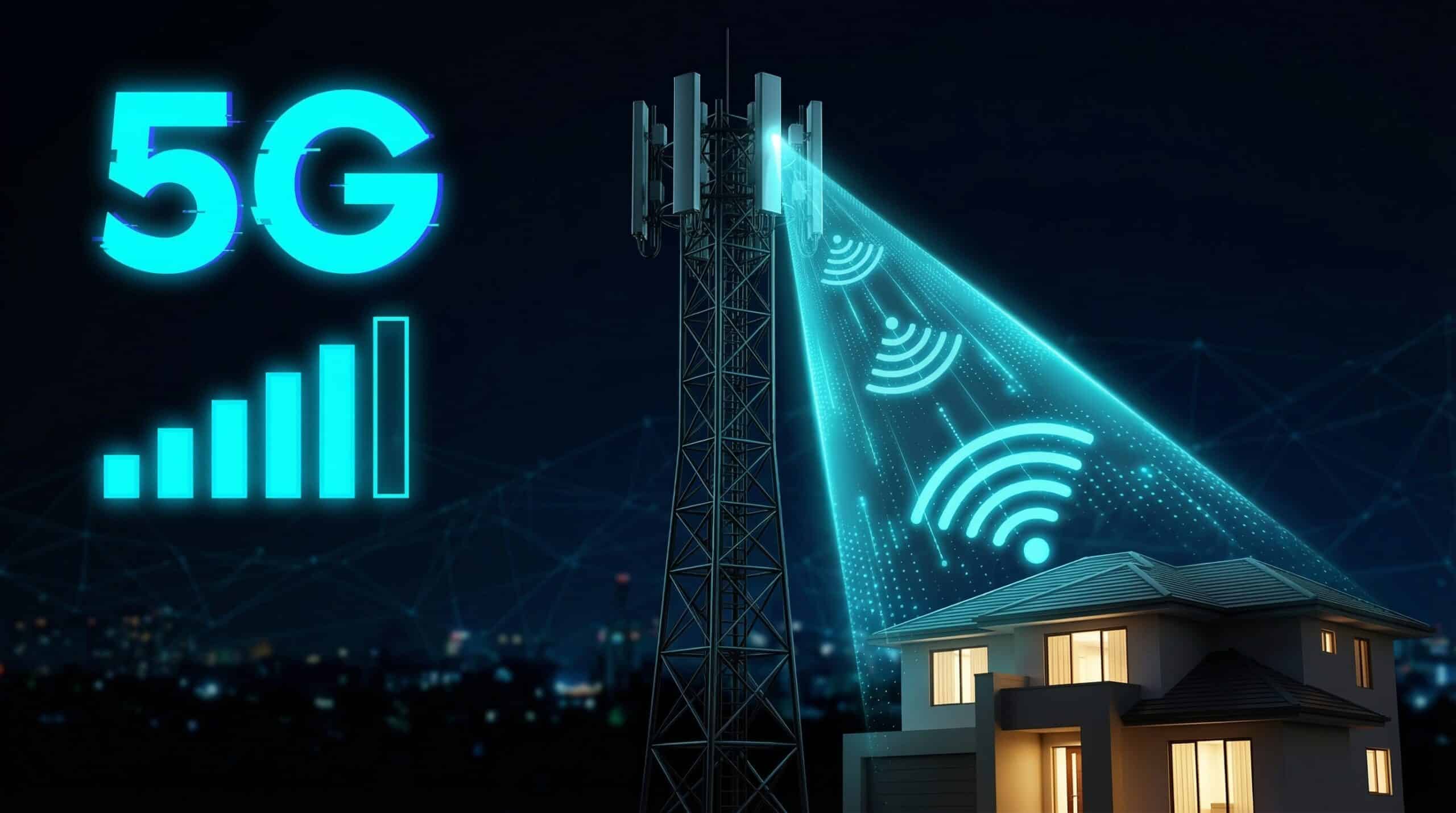
What Is 5G Home Internet?
5G home internet uses the same 5G wireless cellular network that powers smartphones to deliver broadband service directly to your home. A 5G receiver (gateway) installed at or near your home connects wirelessly to a 5G cell tower, eliminating the need for coaxial or fiber cable running to your house. T-Mobile, Verizon, and AT&T are the major US providers, with similar services launching globally. Test your 5G home speeds with our free speed test.
5G Home Internet Speeds — What to Expect
| Provider | Typical Download | Typical Upload | Latency |
|---|---|---|---|
| T-Mobile Home Internet | 72–245 Mbps | 15–31 Mbps | 30–50ms |
| Verizon 5G Home | 85–300 Mbps | 20–50 Mbps | 20–40ms |
| AT&T Fixed Wireless | 25–100 Mbps | 10–20 Mbps | 30–60ms |
5G Home Internet vs Cable — Key Differences
5G home internet’s biggest advantages are availability (no wiring needed) and simplicity (self-install, no technician visit). Its limitations: speeds vary based on cell tower distance, tower congestion, and signal strength; upload speed is significantly lower than fiber; latency is higher than fiber (30–50ms vs 5–15ms). For households in rural or suburban areas where cable and fiber aren’t available or are overpriced, 5G home internet is often the best available option. Compare it against satellite in our Starlink vs 5G home internet comparison.
Is 5G Home Internet Good Enough for Gaming?
For casual gaming — yes. The 30–50ms latency is acceptable. For competitive gaming, it’s marginal — latency spikes during cell tower congestion cause inconsistent ping. 5G home internet typically lacks the consistent low latency that fiber delivers. See our comparison of 4G vs 5G speed to understand the cellular network side of the equation.
Related Guides
- 4G vs 5G Speed
- Starlink vs 5G Home Internet
- What Is T-Mobile Home Internet Speed?
- What Is Fixed Wireless Internet?
- Fiber vs Cable Internet
- How to Test Mobile Data Speed
Frequently Asked Questions
Is 5G home internet as fast as fiber?
Typically no — fiber delivers more consistent speeds, lower latency (5–15ms vs 30–50ms), and higher upload speeds. 5G home internet’s wireless nature means performance varies with signal conditions, tower load, and weather. However, 5G’s 100–300 Mbps downloads are genuinely fast for most household uses; the gap matters most for latency-sensitive applications like competitive gaming and large uploads.
Does 5G home internet have data caps?
Most 5G home internet plans (T-Mobile, Verizon) offer unlimited data with no hard caps but may deprioritize traffic during congestion periods (“network management”). This is different from a hard cap where service stops. Check the specific plan terms — the unlimited designation is generally accurate for everyday household use including streaming, gaming, and video calls.
Can I get 5G home internet in rural areas?
Yes in many rural areas — this is actually one of 5G home internet’s primary use cases. T-Mobile’s Home Internet specifically targets underserved rural areas where fiber and cable are absent. However, 5G coverage maps vary significantly; confirm signal availability at your exact address before subscribing, as even mid-band 5G has coverage gaps.