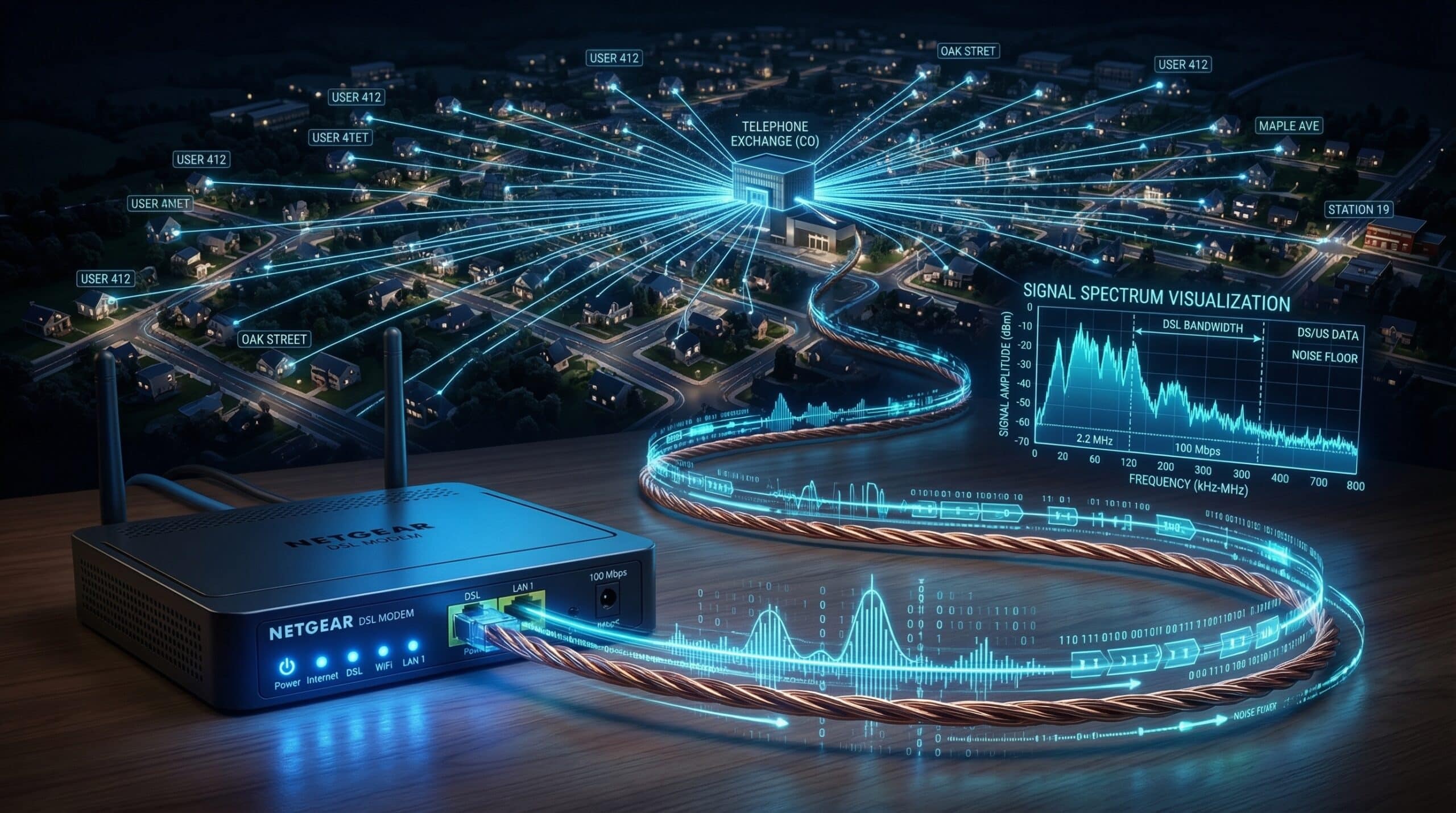
What Is DSL Internet?
DSL (Digital Subscriber Line) internet delivers broadband over existing copper telephone wires. DSL uses frequencies above the voice band, allowing simultaneous phone and internet service on the same line. It was the first mass-market broadband technology, replacing dial-up in the early 2000s, and still serves hundreds of millions of customers worldwide — particularly in rural and suburban areas where fiber hasn’t been deployed. Run a speed test to see how your DSL connection compares to its advertised speed.
Types of DSL — ADSL vs VDSL
| Type | Max Download | Max Upload | Distance Limit |
|---|---|---|---|
| ADSL | 8 Mbps | 1 Mbps | 5.5 km |
| ADSL2+ | 24 Mbps | 3.5 Mbps | 5.5 km |
| VDSL | 52 Mbps | 16 Mbps | 1.2 km |
| VDSL2 | 100 Mbps | 100 Mbps | 500m |
| G.fast | 1 Gbps | 1 Gbps | 250m |
The Big Limitation — Distance Degradation
DSL speed degrades with distance from the telephone exchange (DSLAM). A customer 300 meters away might receive 70 Mbps VDSL2. The same technology at 1.5 km delivers 30 Mbps. At 3 km, you’re limited to ADSL2+ at under 15 Mbps. This distance sensitivity is DSL’s fundamental limitation versus fiber and cable — it physically cannot deliver consistent speeds across geographic areas. If your download speed is slower than your plan, distance from the exchange is a primary suspect on DSL.
DSL Pros and Cons
Pros: Extremely wide availability — wherever phone lines exist; dedicated line per home, not shared like cable; affordable entry-level pricing; adequate for basic browsing, email, and SD streaming.
Cons: Speeds limited by copper wire and distance; heavily asymmetric (slow upload); significantly slower than fiber and modern cable; sensitive to line quality — old or degraded copper causes noise and speed drops; susceptible to interference from rain and moisture affecting performance.
Is DSL Good Enough in 2025?
For a single user with modest needs — light browsing, email, SD streaming — ADSL2+ at 15–20 Mbps is technically sufficient but will show its limits with 4K streaming or video calls. VDSL2 at 50–100 Mbps is genuinely capable for most household uses. If you’re on DSL and have the option to switch to cable, fiber, or 5G home internet, any of those will provide significantly better performance. Compare options in our cable vs DSL guide.
Related Guides
- What Is Cable Internet?
- What Is Fiber Internet?
- Cable vs DSL Internet
- What Is Fixed Wireless Internet?
- Download Speed Slower Than Plan
- Why Is Internet Slow After Rain?
Frequently Asked Questions
Is DSL internet reliable?
Generally yes for the core service — DSL lines are dedicated (not shared like cable’s neighborhood node). However, DSL is susceptible to line quality issues: old copper wiring, poorly connected junctions, and moisture ingress all degrade performance. A dedicated line means neighbors’ usage doesn’t affect you, but your physical line quality has an outsized impact on your speeds.
Why is my DSL speed slow in rainy weather?
Water infiltrating telephone cable junctions or aging insulation causes increased electrical resistance and interference on copper lines. This manifests as reduced speeds, higher error rates, and disconnections. The effect is most pronounced on older copper infrastructure with degraded weatherproofing. Report persistent rain-related slowdowns to your ISP — it often indicates a maintainable fault in the outside plant.
Can DSL reach 100 Mbps?
Yes — VDSL2 can reach 100 Mbps but only within ~500 meters of the DSLAM. G.fast theoretically reaches 1 Gbps but only within 250 meters. In practice, most DSL customers at typical residential distances receive 10–50 Mbps depending on their DSL type and line length. True 100 Mbps DSL requires near-perfect conditions and close proximity to exchange equipment.