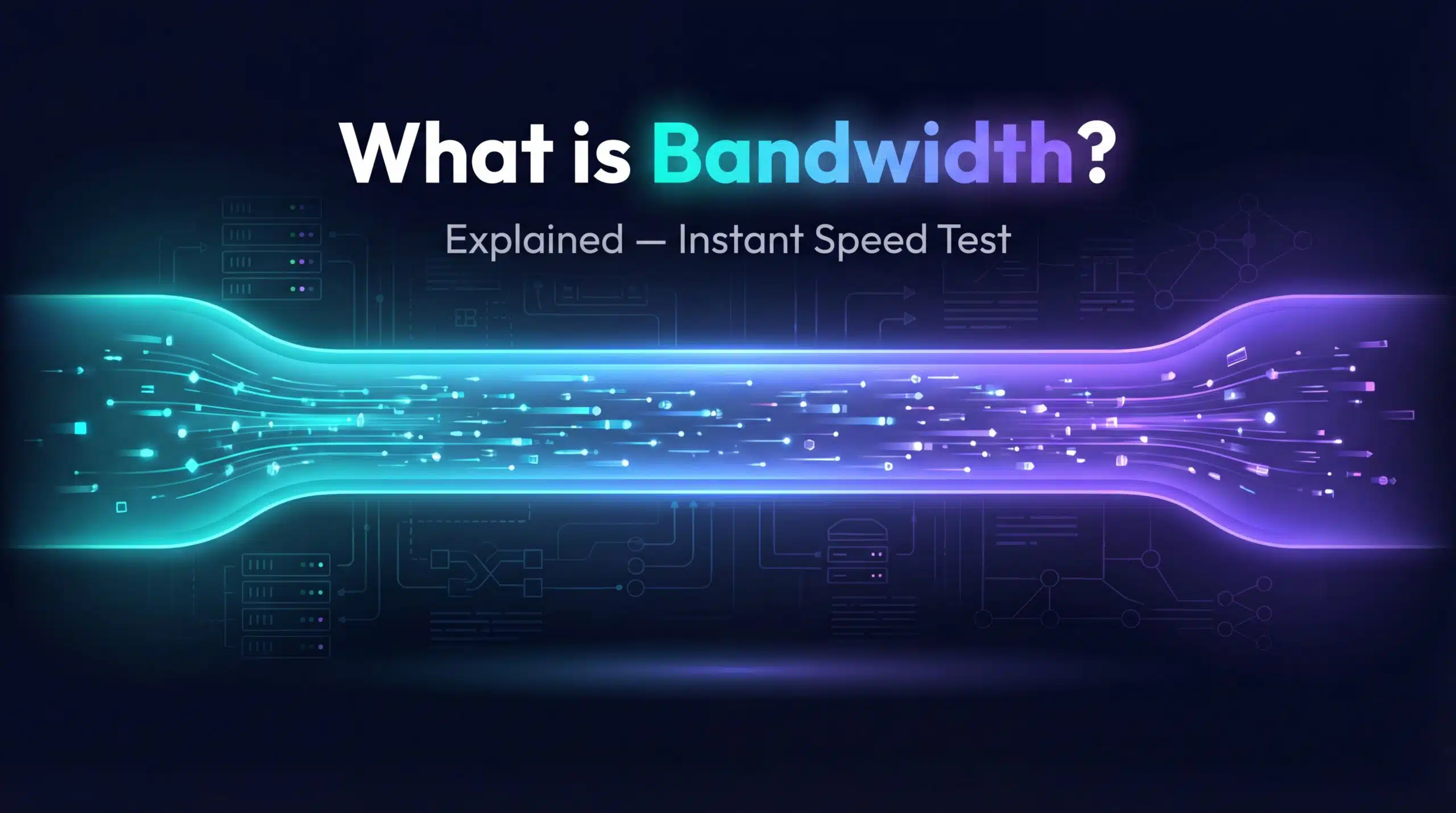
What is Bandwidth?
Bandwidth is the maximum amount of data your internet connection can transfer in a given amount of time. Think of it as the width of a pipe — a wider pipe allows more water (data) to flow through simultaneously, while a narrower pipe restricts the flow regardless of water pressure.
Bandwidth is measured in Mbps (megabits per second) or Gbps (gigabits per second) and is what your ISP advertises when they sell you a “200 Mbps” or “1 Gbps” internet plan. But bandwidth isn’t the same as speed — and understanding the difference is key to diagnosing internet problems. Test your bandwidth right now with our free speed test.
Bandwidth vs Speed vs Throughput
These three terms are often used interchangeably, but they mean different things:
| Term | Definition | Analogy |
|---|---|---|
| Bandwidth | Maximum capacity of your connection | Width of a highway (number of lanes) |
| Speed | How fast data actually travels | Speed limit on the highway |
| Throughput | Actual data transferred in practice | How many cars actually pass per hour |
| Latency (Ping) | How long one packet takes to arrive | Time for one car to drive the full distance |
Your ISP sells you bandwidth (capacity). Your actual experience depends on throughput (what you actually get). These rarely match because of network congestion, protocol overhead, and other factors.
How Much Bandwidth Do You Need?
Bandwidth requirements are cumulative — every device and activity on your network adds up. Here’s how to calculate your household’s needs:
| Activity | Bandwidth Per Device |
|---|---|
| Web browsing | 3-5 Mbps |
| Social media (scrolling) | 3-5 Mbps |
| Music streaming | 1-2 Mbps |
| HD video streaming | 5-10 Mbps |
| 4K video streaming | 25 Mbps |
| Video call (HD) | 5 Mbps ↑ + 5 Mbps ↓ |
| Online gaming | 5-15 Mbps + low ping |
| Large file download | As much as available |
| Smart home device | 1-5 Mbps each |
| Security camera (HD) | 2-5 Mbps ↑ per camera |
Quick calculation: Add up the bandwidth needs for all simultaneous activities in your household, then add 25-50% headroom. A family of four with two 4K streams, one gamer, and one video call needs: 25 + 25 + 15 + 5 = 70 Mbps minimum, so a 100 Mbps plan gives comfortable headroom.
What Eats Your Bandwidth
Many things consume bandwidth without you realizing:
- Cloud backups — iCloud, Google Photos, and OneDrive continuously upload photos and files in the background, eating your upload bandwidth
- Software updates — Windows, macOS, game launchers (Steam, Epic, Xbox), and app updates can download gigabytes at any time
- Smart home devices — Security cameras, smart speakers, robot vacuums, and IoT devices all use a constant trickle of bandwidth
- Browser tabs — Each open tab with auto-refreshing content (social media feeds, news sites, email) uses bandwidth
- Streaming on multiple devices — A 4K TV, someone on YouTube, and music streaming can easily consume 40+ Mbps together
Bandwidth vs Latency
One of the most common misconceptions is that more bandwidth means lower ping. This is mostly false. Upgrading from 100 Mbps to 1 Gbps won’t meaningfully reduce your ping for gaming or video calls.
Bandwidth determines how much data can flow simultaneously. Latency determines how fast each individual packet arrives. You can have massive bandwidth with high latency (satellite internet) or low bandwidth with amazing latency (DSL close to the exchange).
For activities that need responsiveness (gaming, video calls, live trading), low latency matters more than high bandwidth. For activities that need volume (streaming, downloads, backups), high bandwidth matters more.
How to Manage Your Bandwidth Better
- Use QoS settings — Most modern routers let you prioritize certain devices or traffic types. Set gaming and video calls as high priority, downloads as low priority.
- Schedule large downloads — Set Steam, Windows, and backup software to download during off-peak hours (midnight to 6 AM).
- Limit streaming quality — Set Netflix, YouTube, and other apps to 1080p instead of auto (which often picks 4K). This halves bandwidth usage per stream.
- Disable auto-play — Many apps auto-play videos in feeds (Facebook, Instagram, Twitter). Disable this to save bandwidth.
- Monitor usage — Use your router’s admin page or an app like GlassWire to see which devices and apps consume the most bandwidth.
Frequently Asked Questions
Is bandwidth the same as internet speed?
Not exactly. Bandwidth is the maximum capacity of your connection — how much data can flow at once. Speed (throughput) is how much data actually flows in practice. Your actual speed is almost always lower than your bandwidth due to network overhead, congestion, and WiFi limitations.
Why am I not getting my full bandwidth?
Several factors reduce actual throughput: WiFi interference, network congestion during peak hours, old router hardware, VPN overhead, and protocol overhead. Test with Ethernet to eliminate WiFi as a factor. If wired speeds are also low, contact your ISP.
Does more bandwidth mean faster streaming?
Only up to a point. Once you have enough bandwidth for your chosen quality (25 Mbps for 4K), additional bandwidth doesn’t make the stream look better. It does, however, give headroom for other devices to use the internet simultaneously without affecting your stream.
Is 100 Mbps bandwidth enough for a family?
For most families of 3-4 people, 100 Mbps handles simultaneous streaming, browsing, and moderate gaming comfortably. If you have 5+ people or frequently stream 4K on multiple devices, consider 200-300 Mbps. Test your current bandwidth to see where you stand.
What uses the most bandwidth at home?
Video streaming is typically the biggest consumer — a single 4K stream uses 25 Mbps. Large downloads (games, updates, backups), video calls, and security camera uploads are the next biggest consumers. Regular browsing and social media use comparatively little.